AV cabling for HDBaseT and IP video should be selected and tested as structured copper cabling, with particular attention to signal timing, interference, and power delivery. Although the two systems can use similar category cabling and RJ45 connectivity over channels up to 100 meters, their transport methods and deployment models are different.
For dependable video, preserve pair geometry during installation, use cable suited to the pathway and interference conditions, and verify the installed link against the applicable cabling requirements. Where the link also carries DC power, resistance balance and bundle temperature become important considerations. Infrastructure requires the use of a cable analyzer to check for and mitigate image distortion, interference, and remote power supply issues.
Summary: HDBaseT and IP video use similar copper media but are not the same protocol. Category 6A is recommended for multiple HDBaseT cables in one pathway. Delay skew, alien crosstalk, heat, and DC resistance unbalance can affect AV performance. Installed cabling should be certified to the applicable standard.
What is the difference between HDBaseT and IP video cabling?
HDBaseT and IP video may use common category copper cabling and RJ45 connections, but HDBaseT is not packet-based Ethernet video. HDBaseT uses dedicated cables between its transmitter and receiver, whereas IP video travels over the Ethernet infrastructure shared with IP voice and data through switches and routers.
| Aspect | HDBaseT | IP video |
|---|---|---|
| Transport approach | Uses a protocol distinct from packet-based Ethernet | Uses packet-based Ethernet |
| Typical cabling path | Dedicated connection from transmitter to receiver | Shared network cabling through Ethernet switches and routers |
| Common medium | Category copper cabling with RJ45 connectivity | Category copper cabling with RJ45 connectivity |
| Channel distance stated | Up to 100 meters | Up to 100 meters |
HDBaseT can carry uncompressed 4K video, audio, 100BaseT Ethernet data, power, and control signals. Connecting an HDBaseT device to an Ethernet network typically enables its Ethernet function rather than transmitting audio or video through that network connection.
Which installation practices help AV cabling maintain signal quality?
AV links benefit from the same disciplined handling and termination practices used for structured copper cabling. Maintain pair twist, do not exceed the cable bend radius, and keep cabling away from power sources.
Cable quality matters over longer distances, and shielded cable is recommended in noisy, interference-prone environments. These considerations apply to both HDBaseT and IP-based video because both rely on the same type of copper media.
When should Category 6A be considered for HDBaseT installations?
Category 6A is recommended when multiple HDBaseT cables will share the same pathway, because cable bundles can be affected by alien crosstalk. Category 5e and Category 6 may support an individual HDBaseT channel, but they do not have alien-crosstalk specifications.
In a bundle, interference between adjacent cables can degrade performance in a manner similar to high-speed Ethernet bundles. Category 6A provides a more suitable basis for installations where several HDBaseT links run together.
Why does delay skew matter for AV video transmission?
Delay skew is the difference in propagation delay between the fastest and slowest pairs in a four-pair cable. Excessive skew can increase bit errors and jitter; for high-resolution RGB video, where colors may travel on separate pairs, it can contribute to an unstable image.
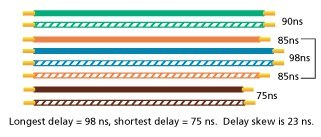
Propagation delay is influenced by cable length, operating frequency, and nominal velocity of propagation (NVP). NVP is stated as a percentage relative to the speed of light in a vacuum; the source data notes that twisted-pair cabling commonly falls in the 60% to 80% range, and a lower NVP corresponds to greater delay.
| Delay-skew reference | Value stated | Relevance to AV cabling |
|---|---|---|
| Industry requirement | Less than 50 ns | Defines the cited maximum limit |
| Video-oriented preference | Less than 25 ns | Described as better for video applications |
| Low-skew cable examples | Closer to 2 or 3 ns | Available from some cabling vendors |
What changes when AV cabling carries POH or PoE power?
HDBaseT can use power over HDBaseT (POH), while IP-based AV can use power over Ethernet (PoE). The source data states that POH can deliver up to 100 W of DC power over four pairs, while IEEE 802.3bt PoE is described at up to 60 W for Type 3 and 90 W for Type 4.
Higher DC power can raise the temperature inside cable bundles, which is relevant because temperature is related to insertion loss. The cited limits are a maximum cable operating temperature of 60°C and a recommended maximum temperature rise of 15°C for remote-power applications.
Note: To limit temperature rise when delivering DC power, the source recommends reducing bundle size, using higher-category or shielded cabling, or reducing channel length. A bundle of 60 Category 6A cables is stated to exhibit about 12% less heat rise than Category 6.
Why test DC resistance unbalance in powered AV links?
DC resistance unbalance is a difference in resistance between conductors within a pair or between pairs. Too much unbalance can prevent current from splitting evenly, saturate a transformer, and distort the video signal.
Consistent termination workmanship and cable quality help maintain balance, while non-compliant copper-coated aluminum (CCA) cables are identified as a higher-risk choice. The source cites a maximum unbalance of 3% between conductors in a pair and a 7% limit between any two pairs relative to their total parallel resistance.
How should HDBaseT and IP video cabling be tested?
Installed cabling for either HDBaseT or IP video should be certified in the same manner as structured LAN cabling, against the applicable cabling standard for the deployed category. If Category 6A is installed, this includes Category 6A certification and alien-crosstalk testing where applicable.
For powered AV systems, test DC resistance and resistance unbalance in addition to the normal cable parameters. The DSX2-8000 is identified in the source as a copper cable certifier that measures delay skew and can verify DC resistance and resistance unbalance for these deployments.