The answer is yes, but the seal's integrity depends on more than just the welding machine. Product design, materials, and the manufacturing process are the decisive factors in determining whether the weld meets waterproofing standards or simply joins two components together.
How does ultrasonic welding create a watertight seal?
Unlike adhesives that form a bonding layer between two surfaces, ultrasonic welding utilizes high-frequency mechanical vibrations to generate heat directly at the contact interface. The material melts locally, fuses together under pressure, and solidifies into a unified whole.
The resulting weld is virtually seamless, making it extremely difficult for water, moisture, or air to penetrate the product. This characteristic makes ultrasonic welding a popular choice for applications requiring a high degree of seal integrity while maintaining rapid production speeds.
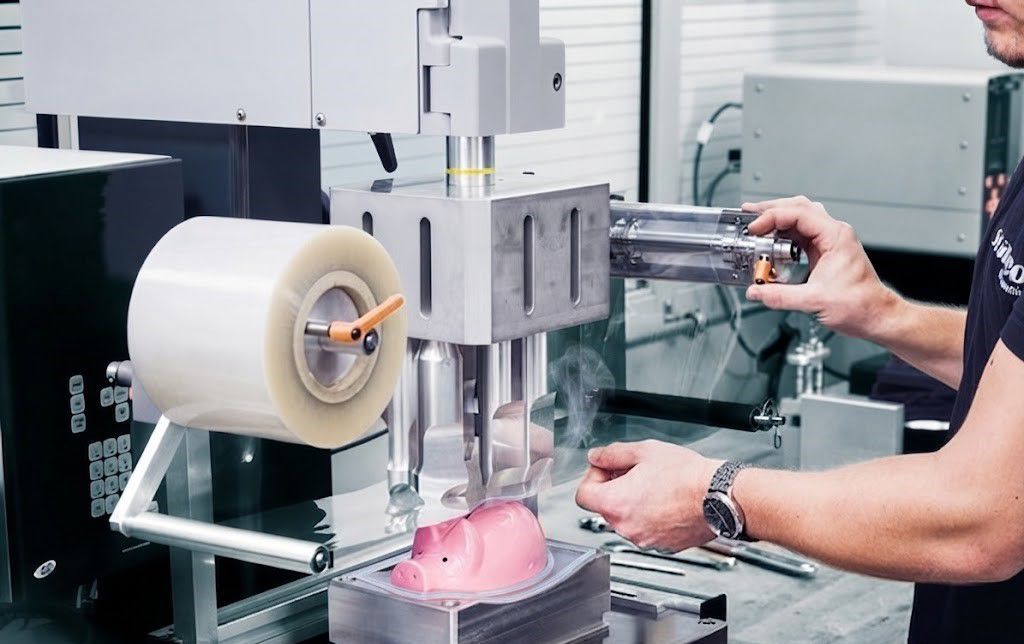
Water resistance does not depend solely on the welding machine
Many people assume that simply using an ultrasonic welding machine guarantees a watertight product. In reality, the welding machine is only one part of the entire process.
An effective design typically incorporates an Energy Directora raised rib feature at the joint interface. As ultrasonic waves are transmitted, this rib melts first and spreads evenly around the entire circumference, sealing any gaps between the two components.
If the design is suboptimal or the material unsuitable, the plastic will not distribute evenly. While the weld may look aesthetically pleasing on the outside, microscopic voids could remain internally, allowing water to seep through after a period of use.
Which products utilize ultrasonic welding for waterproofing?
This technology is utilized in numerous manufacturing sectors that require reliable sealing.
Some common applications include:
- Outdoor LED lights.
- Industrial sensors.
- Waterproof electronic devices.
- Automotive controllers.
- Disposable medical devices.
- Water filter caps.
- Airtight packaging.
- Battery housings and packs.
For these products, ultrasonic welding helps reduce the number of assembly components, eliminates the need for adhesive application, and significantly shortens production time.
Can it meet IP65, IP67, or IP68 standards?
It is entirely possible. Many products meeting IP65, IP67, or even IP68 standards utilize ultrasonic welding during assembly. However, the IP rating is not determined solely by the weld seam itself but is the result of the product's overall design.
To achieve a high level of water resistance, manufacturers must simultaneously control various factors, such as joint geometry, "Energy Director" design, material selection, welding parameters, and mold stability.
Why are many businesses switching from adhesives to ultrasonic welding?
This trend is increasingly prevalent in automated production lines. Adhesives require curing time and are susceptible to the effects of ambient temperature and material shelf life. In contrast, ultrasonic welding is completed in just a few seconds, requires no solvents, eliminates waiting times, and integrates easily into automated systems.
Beyond production efficiency, the component count is significantly reduced, as many products no longer require additional gaskets or adhesives to ensure a tight seal. This is why the technology is widely applied in electronics manufacturing, medical device production, the automotive industry, and various other industrial sectors.
When is ultrasonic welding not a suitable choice?
Despite its many advantages, ultrasonic welding has certain limitations.
For very large parts, it is difficult to distribute energy evenly across the entire surface. Creating a strong bond between plastics with differing melting characteristics is also challenging. Furthermore, products subjected to extremely high liquid or gas pressures may still require specialized gaskets to meet technical specifications. Therefore, the choice of welding technology must be based on the specific characteristics of each product rather than the application of a one-size-fits-all formula.
Tightness still needs to be verified through post-welding tests
Even after the production line has been optimized, many businesses conduct additional tests such as leak tests, air leak tests, or vacuum tests—before the product leaves the factory.
These tests help evaluate leak resistance under real-world conditions while enabling the early detection of defects stemming from materials, welding molds, or the manufacturing process.
If a water leak is detected during testing, the cause typically lies not in the ultrasonic welding technology itself, but rather in the product design or the production process.
For a more in-depth analysis of common defects, you can refer to the article Why Are Ultrasonic Welds Not Airtight? to explore specific causes and their corresponding solutions.
Selecting the right welding system helps maintain consistent quality
The seal integrity of a weld depends not only on operational experience but also on the equipment's ability to control process parameters.
The Danrel ultrasonic welding machines distributed by EMIN allow for the adjustment and storage of various welding programs, accommodating a wide range of materials and product structures. Parameters such as vibration amplitude, weld time, welding force, and hold time can be configured for specific applications, ensuring production stability when switching between product models.
Ultrasonic welding can indeed produce highly secure, watertight seals when product design, materials, and processing procedures are holistically optimized. Its ability to create fast, clean, and consistent bonds has made it a popular choice across many modern manufacturing sectors.
Crucially, it must be understood that watertightness is not solely the result of the welding machine itself, but rather the outcome of a coordinated approach involving design, materials, equipment, and quality control processes. When these elements are properly established from the outset, ultrasonic welding can fully meet the rigorous watertightness requirements of industrial manufacturing.