
Ice Maker
Reliable ice production is essential in many laboratory and industrial workflows, especially where sample preservation, cooling baths, transport conditioning, or temperature-sensitive preparation steps are involved. Choosing the right Ice Maker helps maintain day-to-day efficiency while reducing the time and inconsistency that often come with manual ice handling.
In this category, you can explore laboratory-focused ice making equipment designed for stable output and practical integration into research, testing, and technical environments. The available range includes both flake and snow ice configurations, making it easier to match the machine to the handling characteristics required by your process.
Why ice makers matter in laboratory and technical settings
Unlike general commercial use, laboratory cooling often depends on consistent ice quality and predictable availability. Ice may be needed for temporary sample stabilization, reagent cooling, controlled transport, equipment support, or routine preparation work where temperature control must remain practical and repeatable.
An automatic unit can simplify these tasks by providing a steady source of ice on site. This is especially useful in busy facilities where staff need immediate access without interrupting workflows or relying on external supply.
Flake ice and snow ice: understanding the difference
One of the most important selection points in this category is the type of ice produced. Flake ice is commonly chosen when users need loose, easy-to-distribute ice that can cover surfaces efficiently and support fast cooling in containers, trays, or temporary storage applications.
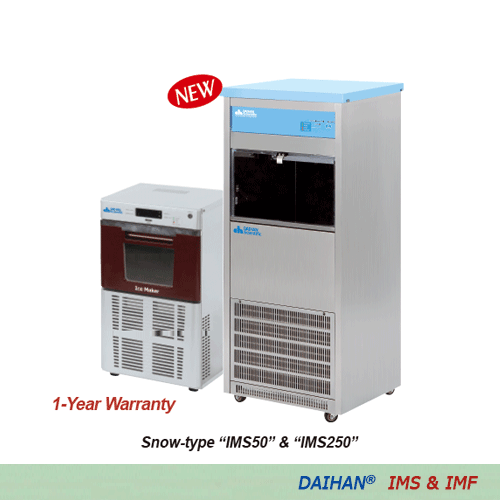
Snow ice, by comparison, is often preferred when a finer texture is useful for close contact around samples or materials. Its form can be advantageous in applications where gentle packing, even coverage, or rapid thermal exchange is important. The right choice depends less on the machine alone and more on how the ice will be handled in your actual process.
Representative models in this category
This range features equipment from DaiHan, including both flake-type and snow-type automatic ice makers. For example, the DaiHan DH.Imf8085 and DH.Imf8125 are flake ice models intended for users who need regular production for routine cooling tasks, while the DH.Ims8055 and DH.Ims8255 represent snow ice options for applications that benefit from a finer ice structure.
The listed models also cover different production capacities, from compact output levels such as 50 kg/day to higher-capacity units including 120 kg/day and 250 kg/day. This spread helps laboratories and technical facilities compare equipment according to actual daily demand rather than selecting purely by footprint or model code.
How to choose the right ice maker
Capacity is usually the first practical filter. A smaller laboratory with intermittent use may be well served by a 50 kg/day unit, while central preparation rooms or shared facilities may require significantly higher daily output. It is important to consider peak usage, not just average consumption, especially if multiple teams draw ice from the same system.
Power supply is another key point. In this category, some models are offered in 230V 50Hz versions and others in 230V 60Hz versions, so compatibility with the installation site should be checked early in the selection process. Matching the ice form, output level, and electrical requirements will usually narrow the options quickly and more effectively than comparing model names alone.
Typical use cases across lab and industrial environments
Automatic ice makers are relevant in research laboratories, quality control rooms, pilot facilities, medical support environments, and technical production areas where short-term cooling is part of standard operating procedures. They can support sample handling, temporary cold storage, process preparation, and transport packaging where a readily available cooling medium is needed.
In many sites, the ice maker is only one part of a broader workspace setup. Supporting tools such as carts and trolleys may help move containers or material between rooms, while task-specific items from other DaiHan laboratory products can complement the overall workflow.
Points to review before purchasing
Before ordering, it is useful to confirm the intended ice type, daily output target, installation power standard, and expected frequency of use. Facilities should also think about how the ice will be collected, transferred, and consumed during the day, because handling practices can affect which model range feels most practical in operation.
Where the ice maker will be used near sample preparation or test activities, operators may also want to review surrounding lab requirements such as protective laboratory apparel and workspace organization. These related considerations do not replace the machine specification, but they help ensure the equipment fits smoothly into the real working environment.
Choosing with confidence
This category brings together automatic ice makers suited to laboratory and technical use, with options spanning flake and snow ice production as well as multiple capacity levels. Whether the priority is compact daily output or higher-volume support for shared operations, the available range gives buyers a clearer way to align equipment choice with process needs.
When comparing models, focus on the practical factors that affect daily use: ice form, output, power compatibility, and workflow fit. A well-matched unit can improve responsiveness in cooling-related tasks and make routine lab operations more consistent over time.
Get exclusive volume discounts, bulk pricing updates, and new product alerts delivered directly to your inbox.
By subscribing, you agree to our Terms of Service and Privacy Policy.
Direct access to our certified experts
