
Roller Mixer
Gentle, continuous mixing is essential when samples need to stay evenly suspended without the shear forces created by more aggressive agitation methods. In many laboratories, that makes a Roller Mixer a practical choice for blood tubes, test tubes, small sample containers, and other applications where repeatable rolling motion helps maintain consistency during preparation or incubation.
On this page, you can explore roller mixer solutions used in routine lab workflows, along with related accessories and brands commonly selected for laboratory mixing and sample handling. The goal is not simply to compare models, but to understand where roller mixing fits within a broader sample preparation process.
Where roller mixers are typically used
A roller mixer is well suited to applications that require uniform, low-impact mixing over time. Instead of creating a strong vortex or rapid directional movement, the rollers rotate tubes smoothly so the sample remains in motion with less risk of foaming or unnecessary stress on the contents.
This type of mixer is commonly considered for clinical, biological, microbiological, and general research workflows. It can be useful for keeping suspensions homogeneous, mixing reagents in closed tubes, or supporting procedures where continuous rolling is preferred over shaking. For users comparing motion types, it may also be helpful to review alternatives such as a digital rotator or a vortex mixer depending on sample behavior and mixing intensity requirements.
How roller mixing differs from other lab mixing methods
Not every sample responds well to the same kind of motion. Roller mixers are generally selected when the priority is steady rotation across multiple tubes at once, especially when users want to avoid the more forceful turbulence associated with vortexing.
That makes this category especially relevant for labs that process batches of tubes in parallel. Compared with more specialized systems, roller mixers often offer a straightforward workflow: place the tubes, start the rotation, and let the sample move continuously. In cases where culture-related rolling is required, users may also compare with roller culture apparatus, which serves a related but more specific purpose.
Representative products in this category ecosystem
One example visible in the current product set is the DaiHan DH.MixR1040 Test Tube Roller Mixer, a lab device intended for test tube rolling applications. Products like this are typically chosen by users who need stable tube movement for routine preparation steps, repeatable daily lab work, or multi-sample processing in a compact bench setup.
The broader product context on this page also includes supporting laboratory items from DaiHan and NEOGEN. While items such as sterile sample bags or centrifuge rotors are not roller mixers themselves, they reflect the surrounding sample-handling workflow often found in laboratories that also use mixing equipment. For example, sterile sample bags may be relevant at the collection stage, while centrifuge accessories support downstream separation after mixing or preparation steps.
What to consider when choosing a roller mixer
Selecting the right unit depends first on the tube format and workload. Laboratories should think about the number of tubes processed at one time, tube dimensions, the duration of mixing, and whether the application calls for simple sample suspension or longer continuous rolling during incubation or preparation.
It is also useful to consider how the roller mixer will fit into the rest of the bench workflow. If the same lab regularly switches between rolling, rotating, and orbital-style sample motion, related equipment categories can improve flexibility rather than relying on a single motion type for every task. The best fit is usually the model that matches actual sample behavior, not just the broad label of the instrument.
Related accessories and adjacent workflow components
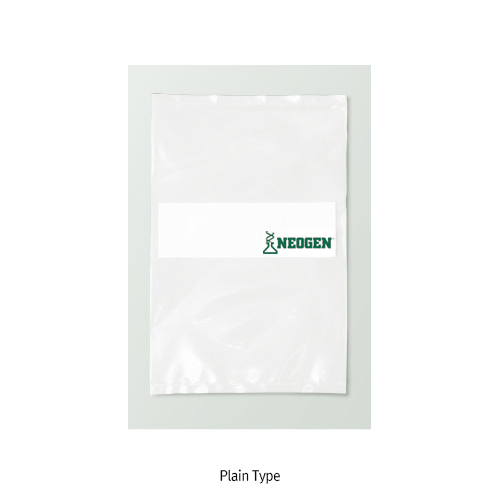
In real laboratory use, a roller mixer rarely operates in isolation. Sample preparation often involves containers, sterile handling products, and post-mixing processing tools. The NEOGEN sample bag range shown in the product context, including plain, wire, filter, and filter-wire formats in sizes such as 150 x 230 mm and 190 x 300 mm, illustrates how sample collection and preparation can connect to later handling stages in the lab.
Likewise, DaiHan rotor accessories such as fixed-angle and swing rotors belong to centrifugation workflows rather than mixing, but they are still relevant to users building a complete sample-processing setup. This broader view is important in B2B purchasing, where buyers often evaluate compatibility across preparation, containment, mixing, and separation steps instead of choosing each item independently.
Why motion control matters for sample quality
When samples settle quickly or contain suspended particles, inadequate mixing can lead to inconsistent aliquots and unreliable downstream results. A roller mixer helps maintain movement in a controlled way, reducing the likelihood that material remains stratified in the tube during handling.
At the same time, gentler rolling can be beneficial where over-agitation is undesirable. That does not mean roller mixing is the answer for every sample, but it is often a sensible option when users want a balance between continuous motion and moderate handling. In laboratories that need a different presentation format or platform motion, a turn table may be worth comparing as part of the selection process.
Choosing within a practical laboratory purchasing context
For procurement teams, technical staff, and lab managers, the key question is usually not just which product is available, but which type of motion best supports the actual method in use. Roller mixers are typically evaluated based on sample type, tube handling needs, process duration, and how they integrate with surrounding equipment already installed in the lab.
This category is therefore most useful when viewed as part of a complete laboratory workflow. If your process depends on gentle tube rolling for repeatable sample preparation, a roller mixer can be a dependable fit. If your application calls for a different agitation pattern, exploring adjacent mixer and rotator categories may help narrow the right solution more efficiently.
By focusing on motion type, sample format, and workflow compatibility, buyers can make a more informed choice from the available roller mixer options. A well-matched unit supports day-to-day laboratory consistency, while the surrounding ecosystem of sample handling and processing products helps create a more reliable overall setup.
Get exclusive volume discounts, bulk pricing updates, and new product alerts delivered directly to your inbox.
By subscribing, you agree to our Terms of Service and Privacy Policy.
Direct access to our certified experts
