New Wood Smell in a Newly Handed-Over Apartment: How to Measure and Handle Formaldehyde (HCHO) Before Moving In
Many people call the sharp, pungent odor when opening a new wardrobe "new wood smell" and wait a few days for it to fade on its own. Yet what is off-gassing is very likely Formaldehyde from the board adhesive—and our noses are not reliable enough to tell what level it has reached.
Where Does Formaldehyde in New Wooden Furniture Come From?
Solid natural timber is almost never a significant source. The main culprits are engineered wood products such as MDF, MFC, plywood, particleboard, and many types of laminated flooring. Because these materials are pressed from fine wood fibers or chips, adhesives are required to bond them together—and many common industry glues, such as urea-formaldehyde resin, contain Formaldehyde. Once pressing is complete, unreacted Formaldehyde remains trapped inside the board core and gradually escapes into the air.

Solid Natural Timber
Contains no industrial bonding resins, resulting in minimal natural emissions and very low buildup in closed rooms.
MDF, MFC, Plywood, Laminate Flooring & Furnishings
Urea-formaldehyde resin inside board cores combines with paints, adhesives, curtains, and new carpets. The tighter a room is sealed with the AC running, the higher the buildup.
Beyond cabinetry and furniture, Formaldehyde can also be present in certain paints, adhesives, new curtains, and carpets. Consequently, a newly furnished home often experiences cumulative emissions from multiple sources simultaneously—and the more airtight the room, the higher the concentration climbs.
Why a Pungent Odor Isn't Always Formaldehyde—and Why Your Nose Can't Be Trusted
Relying on your sense of smell as a gauge poses two problems. First, sharp odors in a newly finished home can come from many other compounds such as paint solvents, glues, and volatile organic compounds (VOCs), so smelling something unpleasant does not automatically mean it is HCHO. Second, odor sensitivity varies widely from person to person, and the nose quickly adapts after spending time inside the room. Some people detect odors at low levels, while others barely notice anything even when concentrations approach recommended limits. In short, your nose can trigger false alarms—or miss real risks altogether.
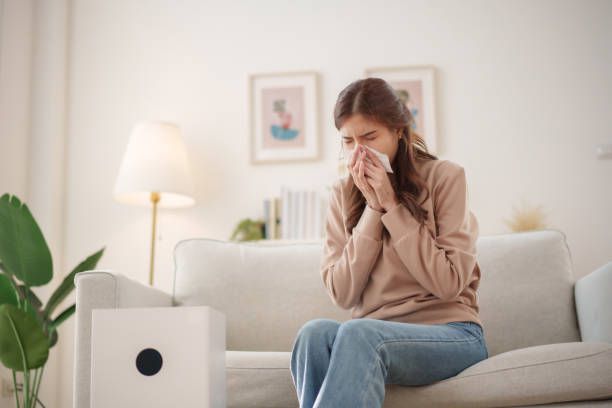
Physical signs such as stinging eyes, a runny nose, scratchy throat, coughing, or headaches in a closed room are worth paying attention to, yet they are non-specific as well—dust, mold, or other allergies cause similar symptoms. To know for sure, you need actual measurements.
How Hazardous Is Formaldehyde, and How Long Does It Off-Gas?
At low to moderate indoor concentrations, common effects are acute irritation—including burning eyes, nasal discharge, sore throat, coughing, skin irritation, and airway discomfort. Young children and individuals with sinusitis, asthma, or allergies are typically more sensitive and develop symptoms sooner. At high, prolonged exposure levels—documented primarily in occupational settings—international cancer research agencies classify Formaldehyde as a human carcinogen. That does not mean a home with a new wardrobe poses an immediate crisis, but it does mean the issue warrants serious action rather than neglect.
The practical reality is that Formaldehyde in a newly furnished home is both measurable and controllable. Most spaces drop to safe levels through proper ventilation and giving wood products time to off-gas—provided homeowners rely on real numbers instead of guesswork.

How Can You Detect Formaldehyde at Home, and Which Method Is Reliable?
There are three testing tiers, ranging from basic observation to instrument-grade precision, depending on your needs:
How to Measure Formaldehyde Properly for Reliable Readings
A reading is only meaningful when taken under proper conditions. Follow this 4-step procedure to capture the worst-case concentration your household might encounter:
Close all doors and windows and turn off exhaust fans for 8 to 12 hours beforehand (for example, testing in the morning after closing up overnight).
Place the meter near the center of the room at breathing height (1 – 1.5 m), away from walls, windows, AC vents, and direct sunlight.
Allow the sensor a few minutes to stabilize before reading the display to avoid fluctuations caused by moving the device.
Record temperature and relative humidity alongside the HCHO reading, as both directly influence off-gassing rates.
What Level Is Safe to Move In, and What Should You Do With the Results?
Common indoor air reference guidelines sit around 0.08 to 0.1 mg/m³. The World Health Organization (WHO) recommends 0.1 mg/m³ as a 30-minute average. One frequent source of confusion is measurement units: 0.08 ppm equals roughly 0.1 mg/m³ under standard room conditions. Always double-check which unit your meter displays before comparing against thresholds.
For nurseries, bedrooms for older adults, or rooms used by people with respiratory conditions, aim well below the limit rather than right on the borderline. If readings sit near or above the threshold, hold off on letting children or seniors sleep in that closed room; increase ventilation, address emission sources, and re-test to confirm improvement before moving in.
Which Methods Actually Reduce Formaldehyde—and Which Are Overhyped?

Evidence-Based Solutions
- Cross-Ventilation: The cheapest and most effective method. Open windows on opposite sides, use fans to push indoor air out, and leave cabinet doors and drawers ajar during the first few weeks.
- Temperature & Humidity Control: Keep rooms cool and dry to slow down off-gassing from engineered wood cores.
- Thick Activated Carbon Purifiers: Help adsorb airborne gases when sized properly for the room and when filters are replaced before saturation.
- Sealing Exposed Board Edges: Apply edge banding or suitable sealants over raw particleboard edges to block emission pathways.
Popular Hacks With Limited Impact
- Houseplants (snake plant, pothos): Make a space feel pleasant, but their absorption rate is far too slow to lower HCHO across an entire room.
- Coffee grounds, pineapple peels, or loose charcoal in corners: Mainly mask odors with stronger scents without removing gas trapped inside wood panels.
- Wiping surfaces with vinegar or salt water: Cleans only exterior surfaces and does nothing to stop ongoing off-gassing from within pressed boards.
You can certainly add plants or natural deodorizers if you enjoy them, as long as you never rely on them to declare a room safe. The only proof that indoor air is safe is an actual measurement.
Key Criteria for Choosing a Formaldehyde Meter—and Recommended Models at EMIN
When selecting an HCHO meter, prioritize these core specifications so you do not end up with a device whose resolution is too coarse:
Popular Formaldehyde (HCHO) Meters Available at EMIN
Well-suited for homeowners moving into new apartments, interior contractors, and indoor air commissioning technicians.
Temtop LKC-1000S+
HCHO · TVOC · PM2.5 · PM10 · Temp/RHSimultaneously measures Formaldehyde (0.001 mg/m³ resolution), fine dust, and TVOCs. Clear display makes it easy to monitor air trends in bedrooms and inside new wardrobes.
Temtop M10 / M10i
HCHO · TVOC · PM2.5 · AQI Color AlertCompact tabletop unit that fits easily inside drawers or cabinets to pinpoint emission sources. High-sensitivity electrochemical sensor with instant color threshold alerts.
Dedicated Handheld HCHO Gas Meter
Electrochemical Sensor · High RepeatabilityBuilt for finishing contractors, furniture showrooms, and engineers requiring stable, repeatable measurements for project handover and compliance verification.
Who Benefits Most From Having a Formaldehyde Meter?
Especially households with young children, older adults, or members with allergies, sinusitis, or asthma checking bedrooms before sleeping with the AC on.
Measuring and sharing transparent air quality numbers at project handover builds client trust and prevents post-handover disputes.
Real-time readings on the showroom floor offer tangible proof when advising customers on low-emission engineered wood materials.
Need Guidance Choosing an HCHO Meter and Testing Your Space Properly?
EMIN's technical team is ready to help you pick the right instrument for your budget and walk you through accurate testing steps for homes or commercial fit-outs.