Why are non-applied leaks difficult to detect and control?
In many non-pressurized systems, leaks are often overlooked due to the lack of differential pressure to create a flow of gas. This makes it difficult to detect errors with traditional measurement methods such as pressure decay. Small leaks also only release tiny amounts of gas or sound, which are difficult to observe with the naked eye or with simple tools such as foam spray.
In addition, old testing methods are often time-consuming, depend on manual operations, and are not accurate enough in complex environments. Meanwhile, a small leak in an aircraft cabin, clean room or electric car compartment can lead to serious performance or safety consequences if not detected in time.
How does the Fluke SB140 Sound Beacon perform in tightness testing?
The Fluke SB140 Sound Beacon offers a completely new leak testing method, especially optimized for non-pressurized systems such as vehicle compartments, tanks, aircraft cabins or clean rooms. Instead of using compressed air or liquid to test for leaks like traditional methods, this device utilizes high-frequency ultrasonic waves to accurately detect the location of leaks.
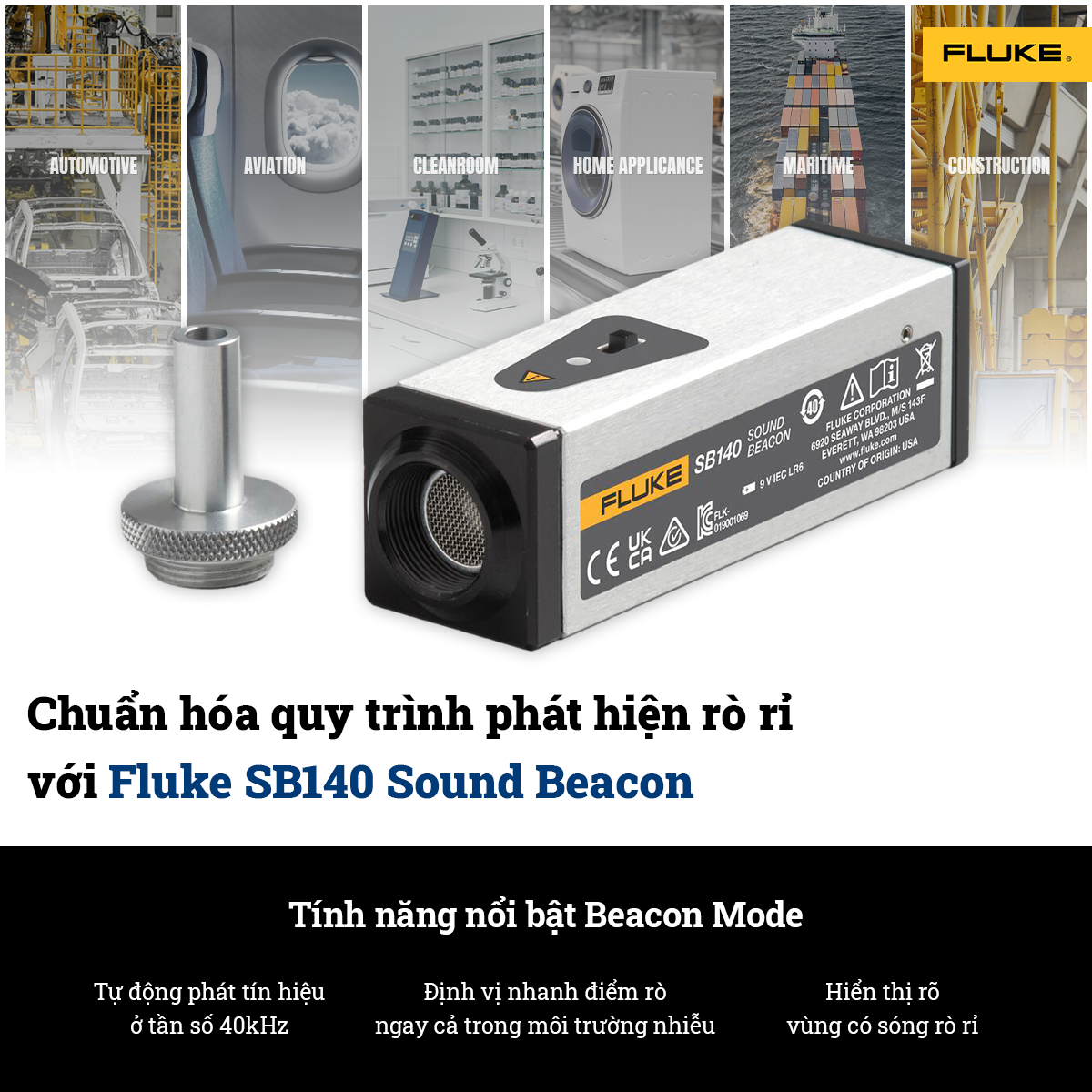
The operation begins with the SB140 Sound Beacon device placed inside the volume to be tested. Thanks to its compact size and robust design, the device can be easily placed in a variety of spaces. When operating, the SB140 Sound Beacon emits ultrasonic waves at a frequency of 40kHz, which is the optimal frequency for transmission through the air with minimal signal loss.
If there are any gaps in the internal volume, the sound waves will leak out through points such as loose welds, aging rubber gaskets, assembly joints or small cracks that are difficult to observe with the naked eye. It is at these locations that the escaping ultrasonic waves will be detected by an ultrasonic imager such as the ii500, ii905 or ii915 and displayed visually on the screen.
This combination allows users to quickly locate leaks in just minutes without destroying the sample or affecting the structure of the device. In particular, with Beacon Mode, the camera will automatically focus on the frequency emitted by the SB140, helping to eliminate background noise and highlight the sound stream that is escaping. This makes it easy for technicians to accurately locate leaks, even in environments with a lot of noise or high reflection.
The effectiveness of this method lies in its ability to detect leaks without creating differential pressure, an important factor for systems that cannot withstand compression or where non-invasive testing is required. This is also why the Fluke SB140 Sound Beacon is increasingly chosen for demanding applications in aerospace, automotive, home appliances and clean rooms.
Explore Beacon Mode for intuitive ultrasound display, find leaks faster
Beacon Mode is the newest feature that helps the SB140 Sound Beacon maximize its working efficiency. This mode automatically locks on the correct 40kHz transmission frequency, eliminates background noise and focuses on displaying the exact leak sound flow as a wave cloud on the Fluke device. As a result, even non-technical users can easily identify and locate leaks, even when inspecting complex structures or noisy environments.
Why is the Fluke SB140 Sound Beacon a worthwhile investment for modern tightness testing?
As quality control procedures become more advanced and non-invasive requirements become the norm in many industries, the Fluke SB140 Sound Beacon has proven to be an indispensable leak tester. Instead of relying on compressed air or liquid to create test pressure, the SB140's method allows for leak detection via high-frequency ultrasonic waves, ensuring safety, no internal pressure, and no disruption to the system structure.
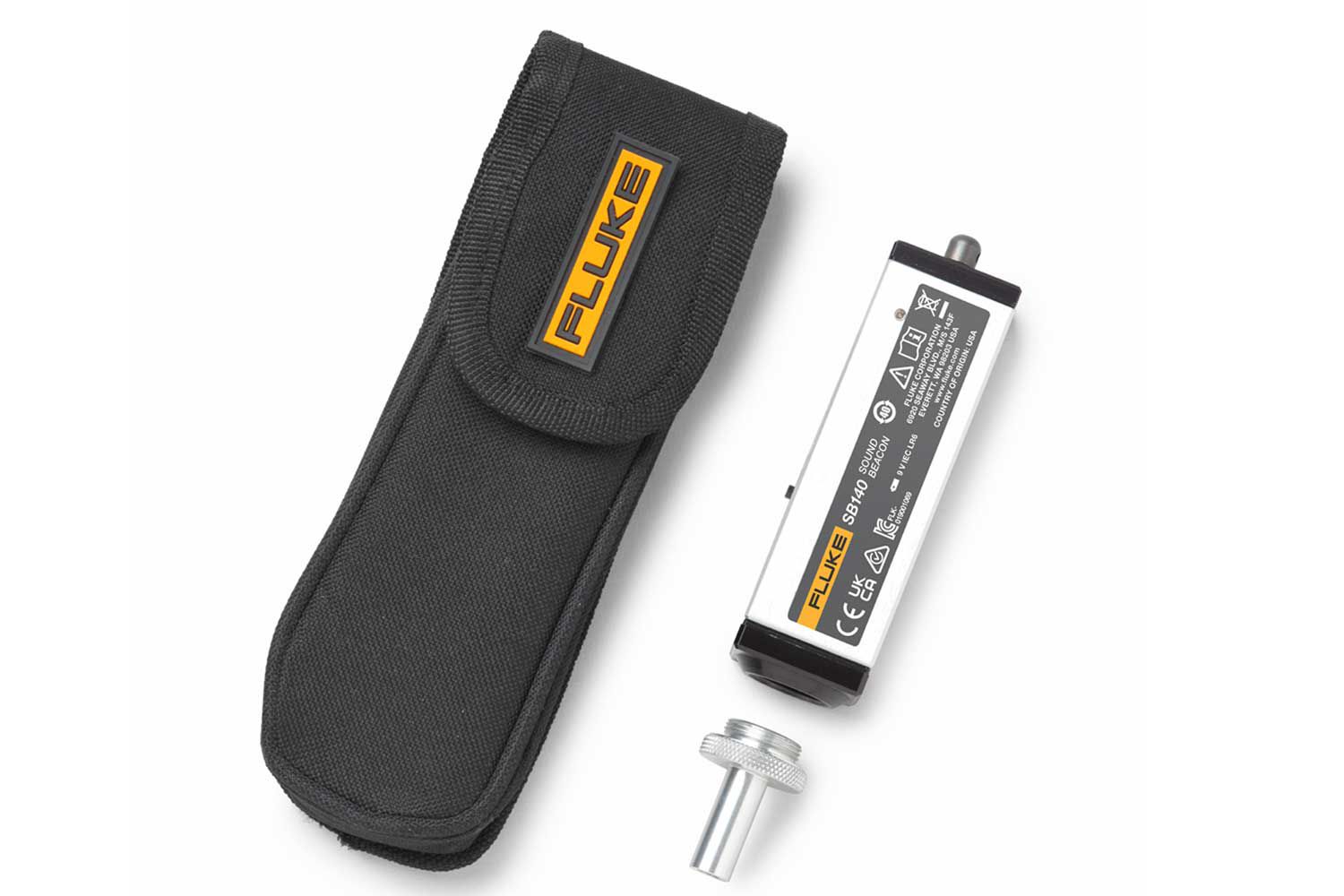
It does not work alone, when combined with Fluke's sonic imager, the SB140 Sound Beacon opens up a whole new experience in leak testing. Users simply place the device in the volume to be tested and use the external sonic camera to monitor the entire process. The ultrasonic stream escaping at the leak location will be clearly and intuitively displayed on the screen, without the need for guesswork or multiple checks as before.
Investing in the Fluke SB140 Sound Beacon is more than just adding another piece of testing equipment; it’s a complete upgrade in how businesses approach leaks. It makes leak testing more accessible, faster, and more accurate. That’s why the SB140 Sound Beacon is poised to become the go-to tool for modern quality inspection.
SB140 is widely used in aviation, automobile, clean room, construction...
While each industry has its own standards for leak testing, they all require a method that is accurate, fast, and non-destructive. The Fluke SB140 Sound Beacon meets these requirements, thanks to its stable ultrasonic output and easy integration with the ii500, ii905, and ii915 series of ultrasonic cameras.
In the aerospace industry, pressure cabins and systems such as pitot-static require periodic leak testing to ensure flight safety. Timely detection of even a small leak can help prevent pressure deviations that can seriously impact performance and safety. The SB140 Sound Beacon allows technicians to perform quick checks during maintenance or inspection of outputs without complicated disassembly.
The automotive industry is also seeing an increased need for non-invasive testing, particularly in electric vehicle battery compartments or automatic window systems. The SB140 Sound Beacon helps manufacturers identify leaks early that could cause water infiltration, sound loss or compromise component durability. Its fast testing speed and simple operation make it suitable for on-line testing, from passenger cars to heavy trucks.
For cleanrooms where any gap can affect microbiological conditions or pressurized air flow, the SB140 Sound Beacon becomes an ideal inspection solution. With stable transmission and visual display via camera, operators can directly monitor and immediately address leaks in a single scan.
In the construction industry, the device helps to accurately identify leaking locations in doors, glass frames, walls or ventilation systems. This is the basis for improving soundproofing, insulation and reducing energy loss. Construction units or building managers can use the device for post-installation, handover or periodic maintenance inspections.
From aviation to civil, the SB140 Sound Beacon not only saves users time but also enhances reliability and professionalism throughout the entire leakproofness testing process. Early and accurate detection of faults also means reduced warranty costs, risk avoidance and improved product quality.
Conclusion
This is why leak detection in non-applied systems needs to be done seriously and correctly – not only to ensure performance but also as a safety factor that is key in many areas.
The Fluke SB140 Sound Beacon offers a simpler, faster and clearer method of leak testing. With accurate detection without the need for differential pressure, this device makes the job easier for technicians and increases the reliability of each step of the test.
In the context of increasingly stringent technical requirements, choosing the right tool is no longer a priority but a must to ensure quality and long-term operational efficiency.