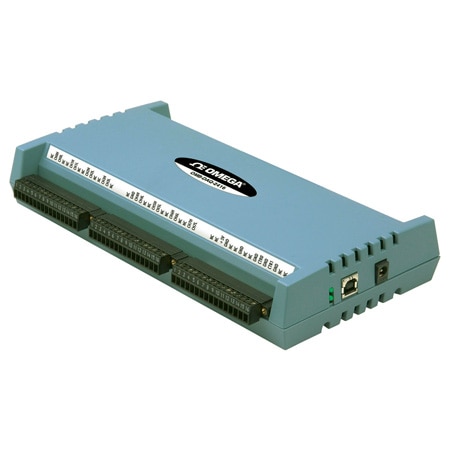
CMRR: Thermocouple Mode: 110 dB, Voltage Mode : 90 dB
Width: 146 mm
Height: 50 mm
Length: 245 mm
Memory: EEPROM
Weight: 463 g
Accuracy: ± 0.025
Bandwidth: 1 MHz
Isolation: 500 Vdc Minimum between field Wiring and USB Interface
Slew Rate: 1.0 V/μs
Input Type: Thermocouple, Voltage
Wire Gauge: 30 to 16 AWG
Output Noise: Output: 30 µVrms
Warm Up Time: 45 min
Digital Input: Digital: Low = 0 Vdc
Output Signal: Digital, Voltage
Sampling Rate: 1 kHz (1,000 updates/second)
Data Interface: Ethernet, USB 1.1, USB 2.0
Digital Output: ±3.5 mA maximum
Supply Current: 340 mA
Supply Voltage: 5 Vdc
Voltage Output: ±10 Vdc
Analog I/O Note: Analog Input Note: A/D CONVERTER;(OMB-DAQ-2416, OMB-DAQ-2416-4AO);A/D Converter Type: 24-bit sigma delta;A/D Data Rates:3750 samples/sec (S/s), 2000 S/s, 1000 S/s, 500 S/s, 100 S/s, 60 S/s, 50 S/s, 25 S/s, 10 S/s, 5 S/s, 2.5 S/s;Input Isolation: 500 Vdc min between field wiring and USB interface;Common Mode Rejection: Thermocouple mode, 110 dB; voltage mode, 90 dB;;ANALOG INPUTS;(OMB-DAQ-2416, OMB-DAQ-2416-4AO, OMB-AI-EXP32);Number of Channels: 16 differential/32 single-ended (thermocouples require differential mode) on OMB-DAQ-2416 or OMB-DAQ-2416-4AO. The OMB-AI-EXP32 is a multiplexer-based channel expansion module that adds an additional 16 differential/32 single ended channels.;Maximum Input Voltage: ±30V (power on), ±10V (power off);Input Impedance: 2 GΩ (power on), 390 Ω (power off);Input Leakage Current: ±10.6 nA (OMB-DAQ-2416, OMB-DAQ-2416-AO); ±20 nA (OMB-AI-EXP32); ±1µA max for input voltage >±30 V;Input Capacitance: 590 pF;Crosstalk: 100 dB adjacent channels;Channel Gain Queue: Up to 64 elements, software configurable channel and range;Warm-Up Time: 45 minutes max (OMB-DAQ-2416, OMB-DAQ-2416-4AO); 15 minutes max (OMB-AI-EXP32);Open Thermocouple Detect: Automatically enable when a channel is configured for a thermocouple sensor.;CJC Sensor Accuracy: ±0.15°C typical (15 to 35°C); ±0.5°C max (0 to 55°C);
Impedance Input: 2 GΩ (power on), 390 Ω (power off)
Leakage Current: ±120 nA
Microcontroller: One high-performance 8-bit RISC microcontroller with USB interface (non-isolated); one high‑performance 16-bit RISC microcontroller for measurements (isolated)
Digital I/O Note: DIGITAL INPUTS Number of Digital I/O Channels: 8 (OMB-DAQ-2416, OMB-DAQ-2416-4AO); 16 (OMB-AI-EXP32) Configuration: Each DIO bit can be independently read from (DIN) or written to (DOUT). The DIN bits can be read at any time whether the DOUT is active or tri-stated. Voltage Range: 0 to 15 Vdc Type: CMOS (Schmitt trigger) Characteristics: 47 kΩ pull-up/pulldown resistor, 28 kΩ series resistor Maximum Input Voltage Range: 0 to 20 Vdc max (power on/off, relative to DGND) Pull-Up/Pull-Down Configuration: All pins pulled up to 5V via individual 47 kΩ resistors (default configuration); pull-down capability is available by moving internal jumper Transfer Rate (Software Paced): 500 port reads or single bit reads per second typical Input High Voltage: 1.3V min, 2.2V max Input Low Voltage: 1.5V max, 0.6V min Schmitt Trigger Hysteresis: 0.4V min, 1.2V max "DIGITAL OUTPUTS (OMB-DAQ-2416, OMB-DAQ-2416-4AO, OMB-AI-EXP32) Number of Digital I/O Channels: 8 (OMB-DAQ-2416, OMB-DAQ-2416-4AO); 16 (OMB-AI-EXP32) Configuration: Each DIO bit can be independently read from (DIN) or written to (DOUT). The DIN bits can be read at any time whether the DOUT is active or tri-stated. Characteristics: 47 kΩ pull-up, open drain DMOS transistor Pull-Up Configuration: All pins pulled up to 5V via individual 47 kΩ resistors by default Transfer Rate (Software Paced): 500 port writes or single bit writes per second typical Output Voltage Range: 0 to 5V (no external pull-up resistor, internal 47 kΩ resistors connected to 5V by default); 0 to 15V max Drain to Source Breakdown Voltage: 50V min Off-State Leakage Current: 0.1 µA Sink Current Capability: 150 mA max continuous per output pin; 150 mA max continuous for all eight channels DMOS Transistor On-Resistance (Drain to Source): 4 Ω";Transfer Rate: Digital: 500 port reads or single bit reads per second typ, Counter: System dependent, 500 reads or writes per second;Sink Current: 150 mA
USB Cable Length: 5 m
Breakdown Voltage: Drain to Source: 50 V
Electrical Output: 0 to 5 Vdc
Input Capacitance: Analog: 590 pf, Counter: 25 pf
Output Resolution: Analog: 16-bits
Relative Humidity: 0 to 90% RH non-condensing
Supply Power Note: Power: 5V ±5%, 340 mA supplied by included AC adaptor (OMB-DAQ-2416-ADAP), User Output Voltage: 5V, 10 mA max available (pin 35), Isolation: 500 Vdc min measurement system to PC
Input Voltage Note: Absolute Maximum Input Voltage: Analog: ±30V (Power On), ±10V (Power Off), Digital: 0 to 20 Vdc max (power On/Off, relative to DGND), Counter: ±20V max (Power On/Off)
Sampling Rate Note: Single channel, 1000 S/s (max, system dependent); multiple channels, 1000 S/s divided by the number of channels (max, system dependent)
Data Interface Note: Output Configuration: Digital: Each DIO bit can be independently read from (DIN) or written to (DOUT). DIN bits can be read at any time whether the DOUT is active or tri-stated.
Input Configuration: Connected Software
Output Settling Time: 45 μs
Electrical Connection: Removable Screw Terminal
Configuration Parameters: Pull-Up/Down Configuration, User-Configurable Input/Output
Storage Temperature, Max: 85 °C
Storage Temperature, Min: -40 °C
Number of Channels, Input: Analog: 32 SE/16 DIFF, Digital: 8, Counter: 2
Voltage Measurement Range: ±0.20, ±10V, ±5V, ±2.5V, ±1.25V, ±0.625V, ±0.3125V, ±0.15625V, ±0.078125V
Number of Channels, Output: Digital: 8, Analog: 4
Operating Temperature, Max: 50 °C
Operating Temperature, Min: 0 °C