Universal Input Data Loggers
When a monitoring point does not fit neatly into a single sensor type, a more flexible logging platform becomes much more practical than deploying separate dedicated devices. Universal Input Data Loggers are used for applications where signal types may vary between voltage, current, thermocouple, or environmental measurements, while still requiring reliable recording, alarm handling, and data access for maintenance, validation, or process review.
In industrial plants, laboratories, building systems, and regulated storage environments, this flexibility helps simplify instrument selection and future expansion. Instead of redesigning the whole monitoring setup when the signal changes, users can choose a logger family that supports broader input compatibility and communication options.
Where universal input data loggers are most useful
This category is relevant when one site needs to capture different kinds of field signals across equipment, utilities, environmental control, or test systems. Common use cases include monitoring analog outputs from transmitters, recording thermocouple temperature points, logging humidity conditions, and tracking process values that need alarms or historical traceability.
Compared with a single-purpose device, a universal input logger offers more room to adapt as instrumentation changes. That can be especially useful in mixed facilities where one area uses 4-20 mA transmitters, another uses 0-5 V or 0-10 V signals, and another needs standalone temperature or humidity logging. For broader network-connected options, readers may also want to review Ethernet and wireless data loggers.
Typical input types and signal flexibility
The products represented in this category show how wide the range can be. Some models are designed for environmental parameters such as internal temperature, humidity, and dew point, while others are intended for more general analog signal monitoring. There are also devices built specifically for thermocouple acquisition where multiple channels and alarm logic are needed.
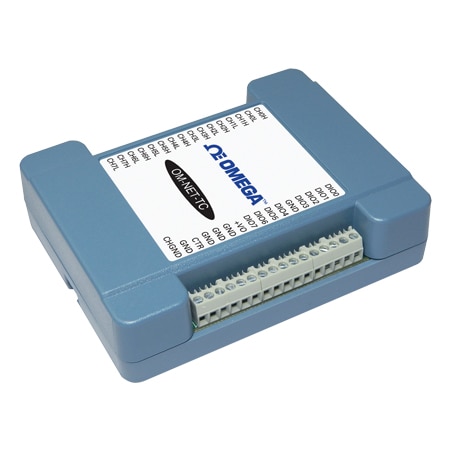
For example, SensoScientific universal sensor models support common analog ranges such as 0-5 V, 0-10 V, and 4-20 mA, which are widely used by industrial transmitters and control outputs. On the temperature side, the OMEGA OM-NET-TC provides multi-channel thermocouple input over Ethernet, making it suitable for applications where several temperature points must be logged at the same time. If your focus is primarily environmental recording, the humidity and temperature datalogger range may be a better fit.
Communication options: USB, Wi-Fi, and Ethernet
Communication method is often just as important as input type. A USB logger may be the right choice when operators periodically download data locally, while Wi-Fi models are useful when remote access, faster response to alarm conditions, or more frequent synchronization is required. Ethernet-based devices are often selected for fixed installations where network stability and multi-point integration matter.
Within this category, Dwyer offers Wi-Fi and USB data logger options that suit environmental monitoring tasks, including models with configurable high and low alarms and onboard memory for long logging intervals. SensoScientific focuses on Wi-Fi-connected universal sensor devices with cloud-oriented monitoring features, while OMEGA addresses wired thermocouple acquisition needs with Ethernet connectivity. The best choice depends on whether your priority is local simplicity, wireless access, or permanent network integration.
Examples from leading product families
Dwyer models such as the DW-WIFI-TH, DW-WIFI-TH-HA, and DW-WIFI-TP-HA are aimed at users who need compact wireless logging for temperature and humidity with selectable transmission intervals and substantial onboard memory. The DW-USB-2-LCD and DW-USB-2-HA-LCD are better suited to straightforward portable logging where a USB workflow is preferred and environmental values such as temperature, humidity, and dew point are important.
For analog signal monitoring, SensoScientific B15-200-OTA, B15-500-OTA, B16-200-OTA, B16-500-OTA, and B14-200-OTA illustrate the role of universal signal inputs in connected monitoring systems. These models are relevant when a facility needs to log standard transmitter outputs rather than only direct environmental sensing. For more specialized thermal measurements, the OMEGA OM-NET-TC stands out as an Ethernet data acquisition module with multiple thermocouple channels and digital alarm capability.
How to choose the right logger for your application
A practical selection process starts with the signal itself. First confirm whether you need to log direct temperature or humidity, a thermocouple input, or an analog process signal such as 4-20 mA, 0-5 V, or 0-10 V. Choosing the wrong input type can create unnecessary conversion steps, added wiring complexity, or compatibility issues with the existing instrument loop.
Next, consider the number of channels, data access method, alarm behavior, and memory strategy. A single-point environmental logger can be enough for storage rooms, cabinets, and mobile validation work, while a multi-channel module is more suitable for equipment skids, ovens, test benches, or distributed temperature measurement. It is also worth checking whether you need local display, programmable alarm thresholds, long-term onboard storage, or continuous network transmission.
Environmental conditions should not be overlooked. Operating temperature range, battery or external power requirements, mounting constraints, and enclosure style can all affect long-term reliability. In some cases, users comparing process-oriented devices may also benefit from reviewing an electric datalogger category when the main task is electrical or signal-based logging rather than mixed-input monitoring.
Benefits for maintenance, compliance, and process visibility
A well-matched logger does more than store readings. It supports trend visibility, makes it easier to identify drift or intermittent faults, and helps teams respond before a condition turns into product loss or process downtime. This is especially valuable where alarm limits must be documented and where historical data is needed for troubleshooting or audit support.
Universal input capability also helps reduce fragmentation in monitoring infrastructure. Instead of keeping multiple isolated devices for different signal types, engineering teams can standardize around a smaller set of logger platforms that better align with plant instrumentation and remote monitoring workflows. That can simplify training, deployment, and long-term maintenance planning.
Matching flexibility with real-world monitoring needs
This category is best approached as a toolkit for varied measurement environments rather than a one-size-fits-all product group. Some applications call for compact Wi-Fi logging of temperature and humidity, others require analog input monitoring tied to cloud alerts, and some demand multi-channel thermocouple acquisition over Ethernet. The value of universal input data loggers lies in that adaptability.
By selecting according to signal type, communication method, alarm requirements, and installation environment, buyers can narrow the options to the devices that genuinely fit their process. Whether the need is environmental monitoring, analog transmitter logging, or thermocouple-based data acquisition, this category provides a practical starting point for building a more flexible and scalable logging system.
Get exclusive volume discounts, bulk pricing updates, and new product alerts delivered directly to your inbox.
By subscribing, you agree to our Terms of Service and Privacy Policy.
Direct access to our certified experts