Pressure Surge Protector
Sudden pressure spikes can shorten the life of gauges, transmitters, switches, and other inline instruments long before the process itself becomes a problem. In many fluid and gas systems, adding the right protective component helps stabilize readings, reduce mechanical shock, and improve the reliability of the overall measurement point.
Pressure surge protector solutions in this category are intended for exactly that role. They are commonly used where pulsation, rapid cycling, or line surges may damage sensitive devices or cause unstable measurement performance.
Why pressure surge protection matters
Pressure instruments are often installed directly on process lines that do not operate under perfectly smooth conditions. Pump discharge lines, compressor systems, hydraulic circuits, and switching valves can create repeated shock loads that travel into the sensing element. Over time, that stress may lead to pointer flutter, premature wear, or reduced accuracy.
A surge protection accessory helps by limiting the impact of those fast pressure changes before they reach the instrument. In practical terms, this can help extend service life, improve reading stability, and reduce maintenance interventions in systems that experience frequent fluctuation.
How these accessories work in a measurement system
Most devices in this category are installed between the process connection and the instrument being protected. Their job is not to replace the measurement device, but to act as a protective interface that dampens sudden transients and moderates pulsation in the line.
For applications that also require broader flow-side support components, it can be useful to review related accessories such as fittings, filters, and mufflers. These supporting parts can help complete a more stable and serviceable installation around the protected measurement point.
Common product types found in this category
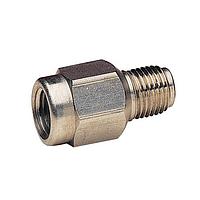
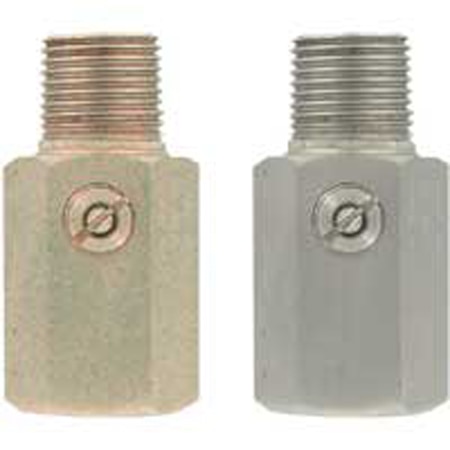
A practical example is the adjustable snubber range from Dwyer, which is designed to protect instruments from fluctuations. Models such as the Dwyer A-260, A-261, and A-262 are intended for NPT connections in different sizes, while Dwyer A-257 and A-258 provide BSPP connection options for installations that require that thread standard.
Material choice is also relevant. Within the listed examples, some versions use stainless steel while others use brass, allowing buyers to align the protector with media compatibility, environmental conditions, and plant standards. The available products in this category are suitable for use with a range of compatible gases and liquids, including water, oils, nitrogen, argon, and alcohol-based media where appropriate.
Selection points to review before ordering
Choosing the right pressure protection accessory starts with the connection details. Thread type and size should match the instrument and process line, so it is important to confirm whether the installation requires NPT or BSPP, and whether the connection size is 1/4 in, 3/8 in, or 1/2 in.
Pressure rating and construction material should also be checked carefully. The products shown here include models rated for demanding service conditions, with certain adjustable snubbers supporting pressure limits up to 5690 psi. Stainless steel versions may be preferred for more aggressive environments or where corrosion resistance is important, while brass versions may be suitable for many general-purpose applications.
- Connection type: NPT Male and Female or BSPP Male and Female depending on the installation standard
- Connection size: available examples include 1/4 in, 3/8 in, and 1/2 in
- Body material: brass or stainless steel depending on process demands
- Media compatibility: confirm suitability for the gases or liquids used in the line
- Temperature range: verify operating conditions before final selection
Example applications across industrial systems
Pressure surge protectors are often specified in systems where the instrument sees rapid pressure cycling rather than a smooth, steady state. Typical use cases include pump outlets, compressor-fed lines, fluid transfer skids, pneumatic systems, hydraulic service points, and general process connections where pulsation can affect indication or control performance.
They can also be valuable where a compact protective component is needed without redesigning the full instrument assembly. In some systems, users may combine surge protection with nearby accessories such as flow tubes or other flow measurement support hardware, depending on how the measurement point is configured.
Related components that support line protection
Not every installation issue comes from pressure spikes alone. In some applications, reverse flow, contamination, or poor line conditioning can also affect instrument performance and service life. That is why buyers often evaluate pressure protection as part of a wider accessory set rather than as an isolated part.
For example, the Dwyer BICV-0N00 brass inline check valve may be relevant in systems where controlling flow direction is also important. In pneumatic installations, related items such as air line lubricators can help support downstream equipment reliability in the broader air handling assembly.
What to look for in listed models
When comparing products in this category, it helps to focus on the practical differences that affect installation and service life. The Dwyer A-254 through A-262 series illustrates how the same protective function may be offered across multiple thread standards, sizes, and body materials. That makes it easier to specify a part that fits the existing pipework and instrument arrangement without unnecessary adapters.
Buyers should also pay attention to the intended medium, ambient and process temperature exposure, and the mechanical demands of the application. A well-matched protector can help maintain more stable operation for the connected device, especially where pressure changes are frequent or abrupt.
Choosing the right option for your system
This category is most useful for engineers, maintenance teams, OEMs, and industrial buyers who need to protect pressure instruments in real operating conditions, not just on paper. The right choice usually comes down to a straightforward review of connection standard, line size, material, media, and expected surge severity.
If your application involves recurring pulsation or sudden line shocks, a properly selected surge protector can be a simple but effective upgrade. Reviewing the available models and matching them to the process connection and operating conditions will help you choose a solution that fits the system and supports longer instrument life.
Get exclusive volume discounts, bulk pricing updates, and new product alerts delivered directly to your inbox.
By subscribing, you agree to our Terms of Service and Privacy Policy.
Direct access to our certified experts