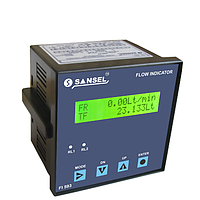
Indicating Flow Meters
In many process lines, it is not enough to know that media can move through a pipe in theory; operators need a quick and reliable way to confirm that flow is actually present. Indicating flow meters help fill that gap by providing visible confirmation of flow conditions at the point of installation, which is especially useful in utilities, water treatment skids, chemical handling systems, and general industrial piping.
On this page, you can explore indicating flow meter options used for direct visual flow verification and basic process observation. These devices are often chosen when maintenance teams want a straightforward solution for checking circulation, spotting interruptions, and reviewing process behavior without adding unnecessary system complexity.
Where indicating flow meters fit in a flow monitoring system
Not every application requires a fully instrumented measurement loop. In many cases, a visual indicator is enough to verify whether liquid is moving, whether the line is active, or whether operating conditions appear normal. That makes this category particularly relevant for support systems, cooling circuits, lubrication lines, and other process segments where fast visual inspection matters.
Compared with technologies designed for continuous quantitative measurement, indicating flow meters are typically selected for local visual monitoring. If your application requires more detailed electrical output or higher-precision volumetric measurement, it may also be worth reviewing electromagnetic flow meters or other instrument types within the broader flow measurement range.
Common product styles in this category
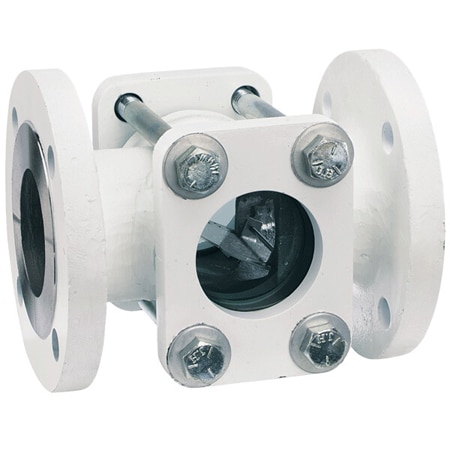
The products highlighted here are centered around sight flow indication, including flanged and threaded designs intended for installation directly into process piping. A visible window section allows personnel to inspect the presence and character of flow, while the process connection style and body material help determine suitability for the installation environment.
Several featured models come from Dwyer, including SFI-300F and SFI-400 series options. Within these ranges, buyers can find different body constructions, connection formats, and line sizes, from smaller threaded units such as the Dwyer SFI-400SS-1-1/4 and SFI-400SS-1-1/2 to larger ANSI flanged versions such as the SFI-350FSS-2, SFI-350FSS-3, SFI-350FSS-4, and SFI-350FSS-6.
How to choose the right indicating flow meter
The first selection point is usually the process connection. Threaded connections can be practical for compact lines and smaller pipe sizes, while ANSI flange connections are often preferred in larger industrial systems that require a more robust mechanical interface. Matching the connection type to the existing piping standard helps simplify installation and reduce rework.
Material compatibility is equally important. In this category, the available products show differences in wetted materials such as stainless steel, steel, glass, PTFE, Buna-N, Fluoroelastomer, and borosilicate. These details matter because the flow indicator must tolerate the media and operating environment; where compatibility is uncertain, the safest approach is to verify the process fluid against manufacturer guidance rather than relying on visual similarity between models.
Buyers should also review orientation, line size, and viewing area. Some featured units support horizontal or vertical mounting, which can be useful when retrofitting into existing skids. The visible window diameter and connection size can influence how easy the unit is to inspect in day-to-day plant conditions.
Understanding the differences between featured models
Within the Dwyer lineup shown here, the SFI-300F family includes larger flanged sight flow indicators with dual-window construction and options described as either no moving indicator or no moving 316 stainless steel flapper configurations. These are suitable examples of how the same general product family can be adapted to different plant preferences, material requirements, and piping sizes.
The SFI-400 Premium models in this category represent another selection path for users looking at smaller connection sizes and a different connection style. For example, the Dwyer SFI-400SS-1-1/4 and SFI-400SS-1-1/2 use NPT female process connections and 316 stainless steel construction details, which may be attractive in systems where threaded installation and corrosion resistance are priorities.
Instead of focusing only on a model number, it is usually better to compare the application context: pipe size, installation method, service media, expected temperature, and whether the operator simply needs visual confirmation or a broader monitoring solution.
Typical industrial applications
Visual flow indication is often used in systems where personnel need to confirm circulation quickly during commissioning, routine inspection, or troubleshooting. Typical examples include cooling water lines, wash systems, filtration loops, process utility circuits, and chemical transfer paths where a local check can help detect no-flow or reduced-flow conditions before they affect the rest of the system.
These devices can also support maintenance workflows. When a technician is checking pumps, valves, or strainers, a sight-based indicator can provide immediate confirmation that a line is active. In broader system design, they are often used alongside complementary devices such as flow valves or with related flow measurement accessories to build a more complete and serviceable flow control arrangement.
When an indicating flow meter is the right choice
An indicating device is a good fit when the primary need is confirmation rather than high-resolution measurement. If operators need to look at a line and determine whether media is present, moving, or behaving as expected, a sight flow indicator can be a practical and low-complexity solution. This can be especially helpful in auxiliary process lines where adding powered instrumentation would be unnecessary or difficult.
On the other hand, if the project requires trending, remote signal integration, or a more direct reading of flow rate, a different instrument family may be more appropriate. In those cases, users often compare this category with paddlewheel flow meters or other meter technologies depending on fluid type, installation constraints, and desired output.
Brands and product ecosystem
This category includes products from established industrial instrumentation manufacturers, with Dwyer as the most visible example in the featured selection. Additional manufacturers associated with this category context include Senseca and Sansel, which may be relevant when buyers are comparing brand portfolios, preferred sourcing standards, or compatibility with existing site specifications.
For many B2B buyers, the real decision is less about brand alone and more about balancing connection style, material construction, piping standard, and the practical visibility needed by operators. That is why category-level comparison can be useful before narrowing down to a specific product page.
Final considerations before you select
Choosing the right indicating flow meter starts with the process itself: fluid compatibility, piping size, mounting requirements, and the level of visibility needed during operation. From compact threaded units to larger ANSI flanged designs, the products in this category support a range of industrial line configurations where direct observation remains valuable.
If you are comparing options, focus on installation fit, wetted materials, and how the device will be used in real plant conditions. A well-matched visual indicator can simplify inspection, support maintenance, and add practical confidence to everyday flow monitoring without overcomplicating the system.
Get exclusive volume discounts, bulk pricing updates, and new product alerts delivered directly to your inbox.
By subscribing, you agree to our Terms of Service and Privacy Policy.
Direct access to our certified experts