A four-quadrant AC source and load supports bidirectional power flow: it can deliver energy to a device under test and absorb energy the device returns. This makes it suitable for power-electronics and grid-related tests where operating conditions change dynamically.
Selection starts with the device under test, including its required power, voltage, current, frequency, and returned-energy behavior. The system must also provide the grid simulation, response performance, control, and protection functions required by the test plan.
Summary: Four-quadrant equipment can source and sink power. Regenerative operation can avoid dissipating returned energy in resistive loads. Evaluate power capacity, electrical range, dynamics, grid simulation, automation, and protection together.
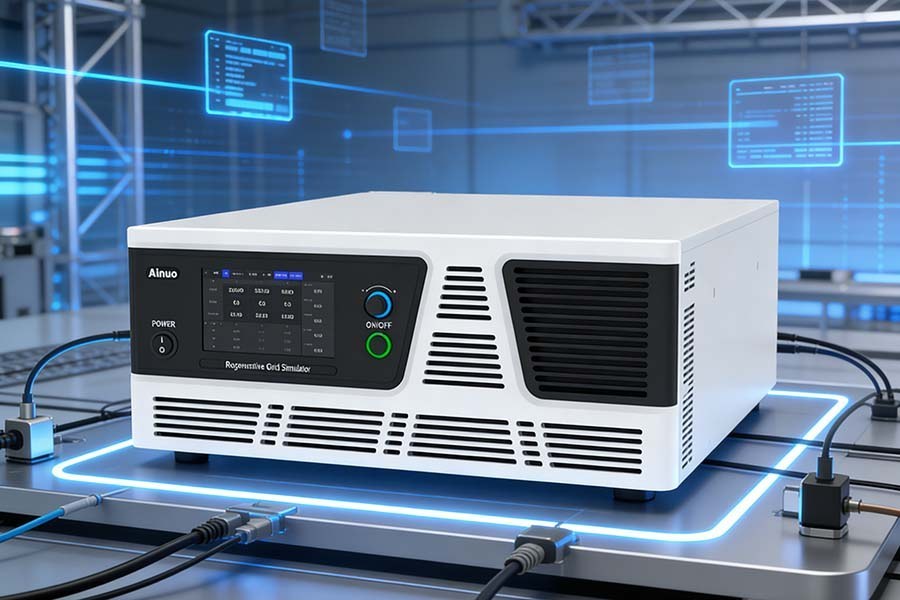
What does four-quadrant operation mean in AC testing?
Four-quadrant operation describes a system’s ability to work with different combinations of voltage polarity and current direction. In practical testing, it enables the equipment to both supply energy and absorb energy returned by the device under test.
| Quadrant | Voltage and current relationship | Power-flow meaning |
|---|---|---|
| I | Voltage and current are positive | Forward power from the source to the device under test |
| II | Voltage is positive; current is negative | The device returns power to the source |
| III | Voltage and current are negative | Reverse-polarity power flow |
| IV | Voltage is negative; current is positive | Another regenerative operating condition |
Why use a four-quadrant AC source or regenerative AC load?
Use four-quadrant equipment when the device under test may return energy, or when the test must reproduce changing grid behavior. A conventional one-quadrant supply can provide power but cannot absorb returned energy, which may instead need to be dissipated as heat through resistive loads.
- Bidirectional testing: supports inverters, motor drives, and EV chargers that can return energy during operation.
- Regenerative operation: returned power can be fed back to the electrical grid rather than burned off in resistors.
- Lower heat burden: avoiding resistive dissipation can reduce cooling requirements.
- Grid simulation: the setup may reproduce voltage sags, swells, frequency variation, phase imbalance, and other disturbances.
Which applications need bidirectional AC power testing?
Bidirectional AC power supply is relevant wherever equipment exchanges power with an AC grid or produces regenerative energy. Common examples include EV charging systems, grid-tied renewable-energy inverters, industrial motor drives, and research into microgrids or energy storage integration.
For EV chargers, a four-quadrant source can simulate grid conditions and support evaluation of regenerative energy flow and power-factor correction. For grid-tied inverters, it can support tests related to synchronization, anti-islanding protection, frequency response, and voltage ride-through behavior.
Motor-drive testing can use this approach to evaluate regenerative braking and changing load behavior. Laboratories studying distributed energy resources and smart-grid control strategies can use it to represent more complex electrical networks.
How should power and electrical range be matched to the device under test?
The source or load must safely cover the device’s maximum expected output or absorbed power, along with the required voltage, current, and peak-current capability. Insufficient capacity can restrict the test scope or affect the validity of results.
Check whether the required test range includes programmable voltage, variable frequency, and single-phase or three-phase output. The source material identifies example ranges of 0–300 VAC or higher and 40–500 Hz or wider, but the necessary range depends on the specific device and test conditions.
Note: Power capacity should be considered alongside possible future expansion, not as an isolated rating.
Which dynamic and grid-simulation functions should be evaluated?
Dynamic performance matters when the device under test experiences sudden load changes, transients, or harmonic disturbances. Relevant specifications include control-loop bandwidth, response time, and slew rate because these affect how accurately the source recreates changing electrical events.
For grid-connected equipment, confirm that the system offers the scenarios required by the test plan. These may include voltage dips and surges, frequency disturbances, phase-angle changes, fault simulation, and islanding scenarios.
Harmonic capability can also be important for non-ideal grid conditions. Where needed, assess programmable harmonic generation, harmonic measurement, and total harmonic distortion control.
What should be checked when selecting a four-quadrant AC load?
A four-quadrant AC load should safely absorb the maximum power the device under test can return and provide the load behaviors required for the application. Unlike a conventional load that only consumes power, a regenerative AC load can feed returned energy back to the grid.
| Selection area | What to verify |
|---|---|
| Load power rating | It can safely absorb the maximum expected power. |
| Regenerative capability | Maximum regenerative power, grid-feedback efficiency, and energy recovery percentage. |
| Operating modes | Whether constant current, constant voltage, constant resistance, and constant power modes are needed. |
| Integration | Compatibility with facility power, rack space, cooling, noise limits, and software environment. |
How do automation and protection affect the choice?
Automation features help make repeated tests more consistent and efficient. Depending on the workflow, assess remote control interfaces, programmable test sequences, data logging, and integration with automated test systems; the source data lists LAN, USB, GPIB, Modbus, and SCPI commands as common communication options.
Protection is essential because these systems can handle high power. Confirm the required overcurrent and overvoltage protection, thermal shutdown, fault detection, emergency-stop function, and, where relevant, diagnostic monitoring and event logging.
When can higher initial cost provide long-term value?
Four-quadrant systems typically have a higher initial cost than conventional AC supplies, but regeneration can lower electricity use and heat-management demands in suitable high-power test environments. Their value also comes from combining bidirectional testing, dynamic load behavior, and grid simulation in one test approach.
The best choice is therefore not defined by a single specification. Select the system that covers the device-under-test requirements and the full testing workflow without assuming performance or features that have not been confirmed for the specific equipment.