
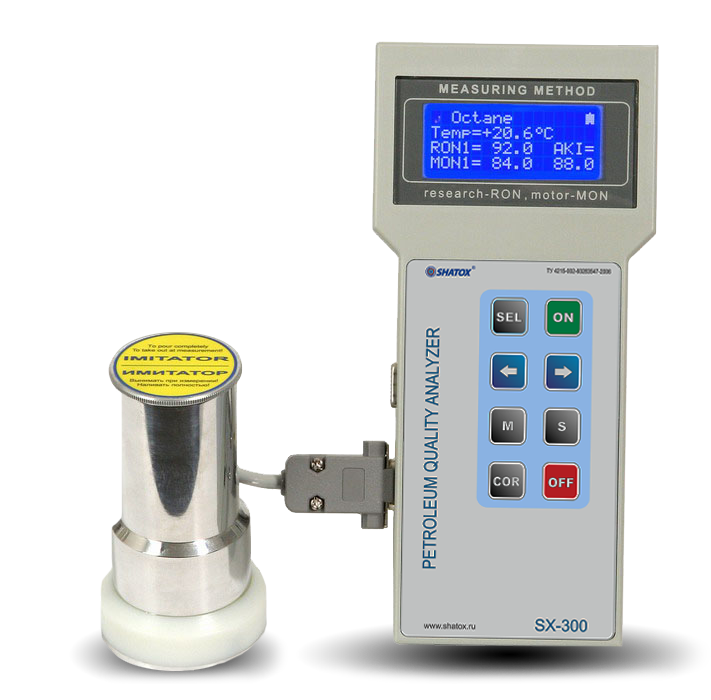
Shatox SX-300 Portable petroleum quality analyzer ((ON) 40–135, ± 0.5)
Measured petrols octane numbers range (ON) 40–135
Acceptable limit of octane number measurement basic error, max (ON) ± 0.5
Limit of acceptable difference between parallel octane number measurements, max (ON:± 0.2
The determination range of antiknock additives content in petrols (%) 0.1-15
Acceptable basic error limit of antiknock additives content determination in petrols(%): 0.1
Petrol oxidation breakdown time measurement range (min) 50-2400
Acceptable basic error limit of petrol oxidation breakdown time(%):10
Petrol quality determination mode basing on volume resistivity (Om) 10^6-10^14
Acceptable basic error limit of volume resistivity measurements(%):3
Cetane numbers measurement range (CN): 20–100
Acceptable basic error limit of cetane numbers, max(CN):±1.0
Acceptable difference limit between cetane numbers parallel measurements, max(CN):± 0.5
Acceptable error limit when determining diesel-fuel pour point (Co): ± 5
Kerosine content determination range in diesel fuels(%):0-95
Acceptable basic error limit when determining kerosene content in diesel fuels(%):3
Motor oils clarity level measurement range(%):95-100
Acceptable error limit of motor oils clarity level measurement(%):0.1
Acceptable difference limit between motor oils clarity parallel measurements(%): 0.01
Fuel and lubricants dielectric permeability measurement range(units): 1–5
Acceptable error limit of dielectric permeability measurement, max(units): 0.001
Acceptable difference limit between Fuel and lubricants dielectric permeability parallel measurements, max(units): 0.001
Oils base number determination range(units):0-24
Acceptable basic error limit when determining oils basic numberBN (units): 1
Motor oils manufacturer and brand determination:Manufacturer-
Circuit-breaker oils (dielectrics) breakdown voltage measurement range (kV): 5–100
Acceptable error limit of circuit-breaker oils breakdown voltage measurement, max (kV): 1
Acceptable difference limit between circuit-breaker oils breakdown time parallel measurements, max(kV): 0.2
Measurement range of circuit-breaker oils loss angle tangen (%):0.01–5
Acceptable error limit of circuit-breaker oils loss angle tangent, max(%): 0.01
Acceptable difference limit between circuit-breaker oils loss angle tangent parallel measurements, max (units) 0.001
Determination range for mechanical impurities content in oil products(%): 97-100
Acceptable basic error limit when determining mechanical impurities content in oil products(%): 0.01
Water-in-oil content determination range for oil products (%): 0-4
Acceptable basic error limit when determining water-in-oil content of oil products(%): 0.01
Measurement time (s) 1–5
Insufficient power supply indication operation threshold (V) 5.4
Instrument useful life (years): 6
Overall dimensions of:
electronic module (mm):211x100x45
sensor #1 and #2 (mm):60х100
Instrument mass with one sensor/two sensors (gr) 850
SHATOX SX-300 Petroleum Quality Analyzer
New oil products grade analyzer is manufactured on the basis of advanced high precision microprocessor. The instrument can be used together with a PC or laptop through USB interface. Analyzer uses automatic computer-based calibration, saving measured data in the instrument memory with analysis date and time followed by their transfer to the PC (in Microsoft Excel or txt format). The instrument has easy of control attrition and aggressive environments resistive 8-key antiglare keyboard (made in Germany).
Analyzer SX-300 has a distinctive characteristic, an additional sensor, which measures oil products volume resistivity with high precision. Therefore, fuel analysis may be based on two values, which allows measuring octane number of petrols with ferriferous (ferrocene), nickel and manganese additives, and to determine other substances content.
By using this measurement principle the instrument allows to determine:
contamination content in oil products;
pour-point depressants content in diesel fuel;
engine oil base number;
oil products volume resistivity.
Video
Get exclusive volume discounts, bulk pricing updates, and new product alerts delivered directly to your inbox.
By subscribing, you agree to our Terms of Service and Privacy Policy.
Direct access to our certified experts