As systems become faster and more interconnected, engineers need to understand how signals interact under the same operating conditions. Sequential testing and setups involving multiple instruments increase complexity and can make it more difficult to isolate system-level interactions.
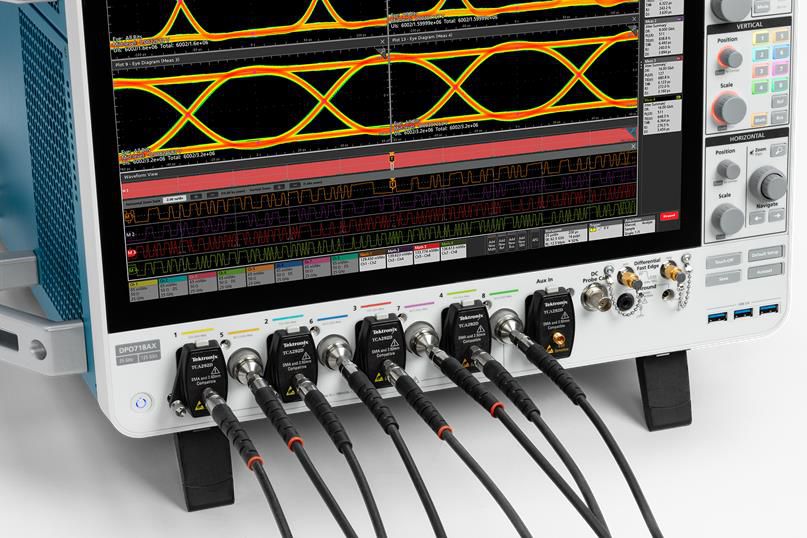
Tektronix, a globally recognized brand in electronic test and measurement equipment, continues to advance measurement technology with the launch of the DPO718AX digital oscilloscope, part of the 7 Series DPO family. It is the first oscilloscope on the market to combine eight synchronized channels with more than 6 GHz of bandwidth per channel and an aggregate bandwidth of up to 25 GHz, providing a comprehensive solution for engineers tackling complex system testing challenges.
Advanced Channel Scaling for Complex System Design
For years, engineers working in advanced research, RF phased-array analysis, and high-speed multi-lane serial data testing have faced a significant limitation: traditional ultra-high-bandwidth measurement instruments typically support a maximum of four channels.
To observe correlations among multiple signals under the same operating conditions, laboratories have often needed to combine two independent high-performance oscilloscopes. This approach increases setup complexity, consumes valuable rack space, and makes it more difficult to isolate system-level interaction faults.
The Tektronix DPO718AX addresses this challenge by doubling the channel count to eight while maintaining a maximum bandwidth of 25 GHz. It can replace two bulky oscilloscopes in applications that require synchronized multi-channel measurements, helping laboratories optimize their workspace within a single 8U instrument chassis.
Introduced in 2025, the 7 Series platform delivers industry-leading signal fidelity, exceptional speed, and advanced measurement analysis capabilities. The DPO718AX builds on this foundation with eight synchronized channels, allowing engineers to choose between four channels operating at 125 GS/s for maximum sample rate and the lowest noise performance, or eight channels operating at 62.5 GS/s for broader synchronized sensing coverage.
This flexibility enables engineering teams to acquire, compare, and correlate more signals in a single acquisition rather than combining data from sequential tests or multiple instruments. It is particularly valuable in applications where a missed, distorted, or uncorrelated signal can affect the results, including photon Doppler velocimetry, broadband laser ranging, spectroscopy, RF phased arrays, electronic warfare, and high-speed serial validation.
For advanced research teams, the additional synchronized channels provide broader sensing coverage and greater measurement redundancy. This helps engineers identify signal loss, timing differences, spatial variations, fault propagation, and signal interactions that instruments with fewer channels might miss.
For RF teams, eight synchronized channels, combined with SignalVu™ PC software, support coherent multichannel RF analysis. Capabilities include spectrum measurements, advanced vector signal analysis, pulse analysis, and radar measurements, helping engineers investigate interdependent behavior in phased-array radar and other broadband systems.
For serial validation teams, simultaneous acquisition of four different signal lanes accelerates testing of multi-lane interfaces used in high-performance computing and consumer I/O applications. This simplifies test setups and helps reveal crosstalk and other system-level interactions.
Breakthrough Specifications and Operational Flexibility
Built on the 7 Series DPO architecture, which combines custom ASICs, optimized FPGAs, and high-performance GPUs, the DPO718AX provides engineers with flexible measurement configurations and advanced analysis capabilities.
Four-channel mode: Delivers a maximum sample rate of up to 125 GS/s, providing the lowest noise performance and optimal signal fidelity.
Eight-channel mode: Provides a sample rate of 62.5 GS/s across all eight synchronized channels, expanding signal coverage for systems with multiple signal paths.
Enhanced system observability: Acquires data from four different serial transmission lanes, multiple RF paths, or additional research sensors in a single acquisition. Engineers can select four channels at 125 GS/s or eight channels at 62.5 GS/s according to measurement requirements.
Exceptional signal fidelity: Uses 12-bit ADC resolution, industry-leading effective number of bits (ENOB), and extremely low random noise to distinguish actual device behavior from measurement-system noise. QuietChannel™ technology actively compensates for high-speed signal loss to help improve measurement accuracy.
Longer event capture: Captures 500 million data points at the standard record length, expandable to 2 billion points in either four- or eight-channel operation, enabling detailed observation of extended measurement events.
High-speed data processing: Uses 96 GB of memory and GPU acceleration for rapid processing, then transfers large datasets from the instrument through a 10 GbE SFP+ interface and the TekHSI™ library.
Modern workflows: Uses TekScope™ PC to analyze and compare data from up to four oscilloscopes on a single screen, making off-instrument data review and cross-system comparisons easier.
In-depth application analysis: Performs comprehensive jitter analysis and eye-diagram analysis across multiple NRZ and PAM signals simultaneously. Signal integrity models can separate signal paths to DUT pins, model actual signal paths, and perform equalization. Alternatively, SignalVu PC can be used for RF spectrum, vector signal, pulse, and radar analysis.
QuietChannel™ technology: Applies continuous-time linear equalization to compensate for high-speed signal loss directly within the instrument's signal path.
Advanced preamplifier and ADC architecture: Delivers high measurement accuracy, sensitivity, and reliability through Tektronix's proprietary low-noise Tek85 preamplifier, 12-bit Tek79 ADC, and advanced DSP algorithms. These technologies help capture and measure signals more accurately while digitizing them at high resolution.
Designed for scalability: Allows bandwidth upgrades from 8 GHz to 25 GHz as requirements evolve and supports a wide range of compatible probes and adapters across the 7 Series product family.
Explore other oscilloscope models at here.