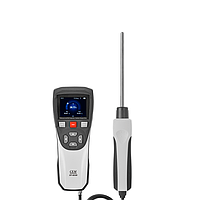
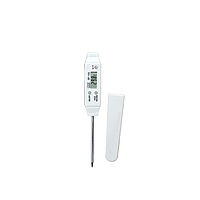
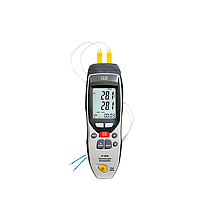
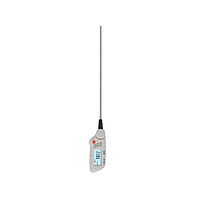
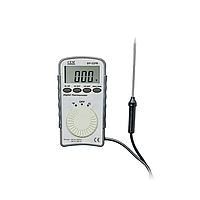
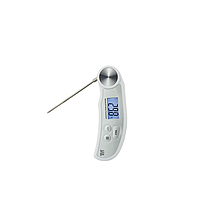
Portable Contact Thermometer
Fast, repeatable temperature checks are essential in maintenance, quality control, HVAC work, food storage verification, and many process environments. When the measurement point is close at hand and direct sensor contact is possible, a Portable Contact Thermometer offers a practical way to capture surface, air, liquid, or probe-based readings with good control over accuracy and response.
Compared with non-contact methods, contact thermometers are often chosen when users need a direct reading from the medium itself or when probe selection matters as much as the meter. This category covers handheld instruments and related probe-based solutions used across industrial service, laboratories, refrigeration, and general technical inspection.
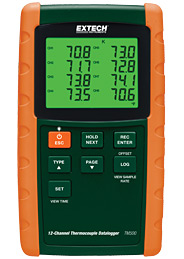
Where portable contact thermometers fit best
A handheld contact thermometer is especially useful when temperature must be measured at the point of contact rather than estimated from emitted radiation. Typical use cases include checking pipe surfaces, HVAC outlets, production equipment, refrigeration compartments, storage conditions, and general troubleshooting in electrical and mechanical systems.
These instruments are also common in applications where operators switch between different probe styles for different tasks. A bead probe may be suitable for fast-response spot checks, while surface or penetration probes are better suited to solids, packaging, or product checks. If your workflow depends on interchangeable sensors and direct readings, this category is often a better fit than a remote-only device such as a thermal imaging camera.
Common instrument types in this category
Within this range, buyers will typically find both single-input and dual-input handheld thermometers. Single-input models are straightforward for routine measurement at one point, while dual-input models are useful for comparing two locations at the same time, such as inlet versus outlet, ambient versus process, or product versus reference.
Examples in this category include the FLUKE Fluke-51 II for single-input measurement and the Fluke-52 II or Fluke 54-II B for dual-input measurement. For users who need data capture capability in addition to spot measurement, the Fluke-53-II B shows how some handheld instruments extend beyond basic display functions into logging-oriented tasks.
There are also more application-specific products, such as the Dwyer DRFT-10 series for refrigerator and freezer monitoring, and probe-focused options like the Chauvin Arnoux SK13 and SK14, which play an important role when the measurement challenge depends more on sensor form factor than on the meter body itself.
Probe and sensor compatibility matters
One of the most important selection points for a portable contact thermometer is the sensor technology it supports. Many industrial handheld models use thermocouple inputs, especially Type K, but this category also includes solutions based on thermistor sensing for narrower but often highly practical temperature ranges.
The FLUKE handheld models listed here support multiple thermocouple types, including J, K, T, E, N, and in some cases R and S. That broad compatibility is useful in plants or service organizations where different temperature ranges and probe styles are needed across multiple jobs. By contrast, the Dwyer DRFT-10 variants use a thermistor approach for refrigerator and freezer applications where simplicity and everyday usability are more important than extreme high-temperature coverage.
Probe choice can directly influence response time, achievable range, and contact quality. If your application requires replacement sensors, extension leads, or dedicated probe formats, it is also worth reviewing related temperature accessories and connection components before standardizing on a meter platform.
How to choose the right handheld thermometer
The best choice depends less on brand name alone and more on the measurement task. Start with the expected temperature range, then confirm the sensor type, input count, display resolution, and the physical style of probe required for the target surface or medium. In many maintenance environments, a dual-input unit is more efficient because it supports comparison and faster diagnostics without carrying two separate instruments.
For broad industrial use, models such as the Chauvin Arnoux TK 2002 and FLUKE handheld thermometers are relevant examples because they support probe-based flexibility and practical portable use. For refrigeration or cold-storage spot checks, a compact product like the Dwyer DRFT-10 may be more appropriate than a higher-range industrial thermocouple meter. For specialized measurement chains, sensor items such as the KEYSIGHT E2308A thermistor temperature probe or HORIBA 4163-10T temperature compensation electrode highlight how some applications depend on specific sensing elements rather than a general-purpose handheld display.
- Use single-input models for routine one-point checks and basic maintenance tasks.
- Use dual-input models when temperature comparison is part of troubleshooting or validation.
- Choose thermocouple-based instruments when wide range and interchangeable probes are required.
- Choose thermistor-based solutions when the application focuses on narrower ranges with simple operation.
Typical applications across industry and facilities
Portable contact thermometers are used in a wide range of B2B settings. In HVAC and building services, they help technicians verify duct temperatures, pipe conditions, and equipment performance. In food storage and cold-chain environments, they are useful for refrigerator or freezer checks where direct sensor placement gives a more dependable reading than a visual estimate.
In manufacturing and laboratories, these devices support equipment verification, incoming inspection, routine process checks, and troubleshooting of thermal irregularities. Where permanent installation is not required, a handheld meter remains a flexible tool for commissioning, preventive maintenance, and field service. If the requirement is mainly for panel-style or fixed readout devices rather than handheld operation, users may also want to compare options in temperature meters and indicators.
Examples from leading manufacturers
This category includes products from recognized instrument brands with different strengths. FLUKE is well represented with single-input, dual-input, and wireless-related temperature solutions. The Fluke-51 II, Fluke-52 II, and Fluke 54-II B illustrate a progression from straightforward handheld measurement to more versatile multi-point use, while the FLK-T3000FC points toward wireless module-based workflows in certain maintenance setups.
Chauvin Arnoux contributes both handheld instruments and compatible probes, which is useful for users who want a meter-and-sensor ecosystem rather than a fixed all-in-one arrangement. Dwyer offers simpler application-focused thermometers suitable for refrigeration tasks, while KEYSIGHT and HORIBA appear in more specialized sensor-related roles. This mix is valuable for buyers who need anything from general field thermometry to more targeted sensing and compensation functions.
Good practice for reliable temperature measurement
Even a capable handheld thermometer depends on correct technique. Probe placement, contact pressure, sensor style, and stabilization time all affect the reading. Surface measurements in particular require attention to probe geometry and thermal contact, while air and liquid measurements may require waiting for the reading to settle before recording the result.
It is also important to match the probe to the environment. High-temperature points, narrow spaces, moving equipment, and food-safe applications may all require different sensor constructions. Where cable routing, replacements, or custom lead lengths are part of the job, related temperature wire and cable products can become part of the overall measurement setup.
FAQ
What is the difference between a contact thermometer and an infrared thermometer?
A contact thermometer measures temperature through a probe or sensor touching the target or being inserted into the medium. An infrared thermometer estimates temperature remotely from emitted radiation, which is useful for fast scans but not always ideal when direct contact measurement is required.
When should I choose a dual-input thermometer?
A dual-input model is useful when you need to compare two points at the same time, such as supply and return lines, ambient and process temperature, or product and reference conditions.
Are probes as important as the handheld meter?
Yes. In many applications, probe type has a major impact on response time, usable range, and measurement quality. The meter and the sensor should be selected together, not as separate decisions.
Choosing the right portable contact thermometer comes down to measurement range, sensor compatibility, application environment, and how the instrument will be used in the field. Whether you need a simple handheld unit for routine checks or a more flexible probe-based platform for technical work, this category provides practical options for direct temperature measurement across maintenance, refrigeration, laboratory, and industrial settings.
Get exclusive volume discounts, bulk pricing updates, and new product alerts delivered directly to your inbox.
By subscribing, you agree to our Terms of Service and Privacy Policy.
Direct access to our certified experts