Textile metamerism control is an important part of quality control and inspection when fabrics, trims, and finished garments move between factories, retail environments, and end users. A color match that appears acceptable under one light source may look visibly different under another. This can create avoidable rework, approval delays, and color-related discussions across the supply chain.
Managing this risk requires more than checking a sample under a single inspection light. A structured process combines visual assessment with digital measurement, evaluates samples under relevant illuminants, and records objective data for comparison.
What Is Metamerism in Textile Color Evaluation?
Metamerism describes a situation in which two samples look alike under one lighting condition but look different when the lighting changes. In textile and apparel production, this can occur when a dyed fabric and an approved reference use different dye combinations or have different spectral reflectance characteristics.
Why Can Fabric Change Color Under Different Lighting Conditions ?
The color perceived by the human eye depends not only on the material itself but also on the light source and viewing conditions. When the light source changes, the spectral composition illuminating the surface also changes, affecting the amount of light reflected at different wavelengths. As a result, two fabric samples may appear nearly identical under one light source but show more noticeable color differences under another.
Different light sources have different spectral power distributions. Therefore, Color Assessment Cabinet using standard illuminants helps assess samples under controlled and highly repeatable lighting conditions. This approach is commonly used to minimize variations caused by the lighting environment when comparing the colors of fabrics, dyes, and other colored materials.
In a light booth, D65 is commonly used to simulate standard daylight conditions, making it suitable for a wide range of color evaluation and quality control applications. TL84 is typically used to simulate fluorescent lighting commonly found in retail stores, shops, and other commercial environments. CWF is another fluorescent light source often used to evaluate colors under lighting conditions similar to those found in offices and retail environments in North America. Meanwhile, Illuminant A has a spectral distribution that is more concentrated in the red-yellow region and is suitable for evaluating color under conditions similar to incandescent lighting.
Observing samples under multiple light sources helps detect color changes caused by different lighting conditions, a phenomenon associated with metamerism. For example, two dye formulations may appear closely matched under D65 but show noticeable differences when the lighting is changed to TL84, CWF, or Illuminant A. This is particularly important in the textile industry because fabric colors may be evaluated at the factory, in stores, and at the point of use under different lighting conditions.
A Light Booth Can Be Used For:
Color approval: Comparing production samples with approved standards.
Pre-shipment color inspection: Evaluating color consistency before products are shipped.
Batch-to-batch color comparison: Checking color differences between different material or production batches.
Common Light Sources for Textile Assessment
- D65: Artificial daylight with a 6500K color temperature, commonly used as a baseline for daily color evaluation.
- TL84: A 4000K fluorescent light source associated with retail environments in Europe, China, and Japan.
- CWF: A 4150K cool white fluorescent lamp used in U.S. mall and office environments.
- Source A: A 2856K tungsten light condition associated with warm shop-window, showroom, or home lighting.
Using Measurement Data to Identify Metamerism Risk
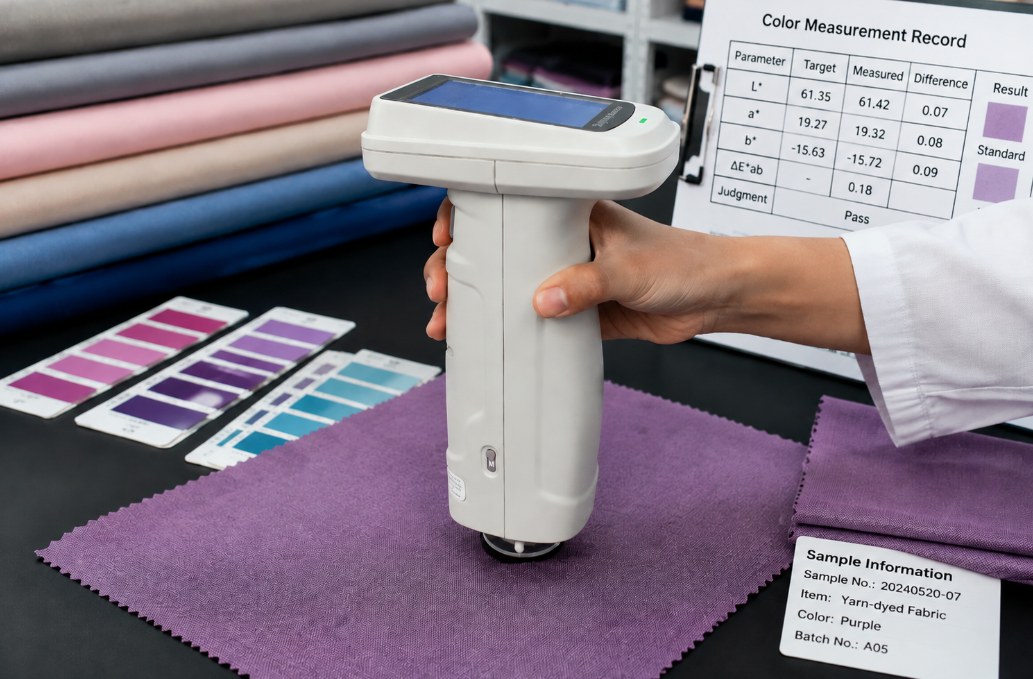
A spectrophotometer measures the color characteristics of a sample and supports comparison under different light sources. In a multi-light workflow, teams can review color difference values such as ΔE under the chosen conditions. The Metamerism Index (MI) can also be used to express the metameric relationship between a test sample and its reference.
When samples have a small difference under D65 but a larger difference under TL84 or another required illuminant, the result signals a potential metamerism risk. The acceptance threshold should follow the customer's defined requirement. This approach gives dyeing, R&D, and inspection teams a clearer basis for deciding whether a formulation needs further adjustment.
Digital records can also improve communication. Rather than relying solely on verbal descriptions of a visual mismatch, teams can share consistent measurement results across sampling, production, and final inspection stages.
CHN SPEC Benchtop Options for Multi-Light Evaluation
The spectrophometer offers both quantitative analysis and wavelength-based optical characterization capabilities, enabling a deeper understanding and control of color.
For laboratory color matching and formulation work, the CHN SPEC DS-700D is described as a precision benchtop spectrophotometer with dual-optical-path spectral analysis. Its stated wavelength range is 360nm–780nm, and it supports standard light sources including D65, A, C, D50, D55, D75 and F1-F12, including TL84, CWF, and U30. The model is also described as having multiple measurement apertures for materials such as fabric yarns, buttons, and accessories.
The CHN SPEC CS-821N Series is presented for applications requiring consistent color data across supply-chain participants. With compatible color management software, the series can provide reports containing ΔE and Metamerism Index data under multiple light sources.
Textile metamerism control starts with recognizing that a color approval under one lamp is not necessarily a reliable result in every environment. By integrating multi-light source measurement into dye development, color matching, production checks, and final inspection, textile teams can make color decisions more objective and identify potential mismatches earlier in the process.
Building a Practical Textile Metamerism Control Process
- Define the reference and viewing conditions. Identify the approved standard and the illuminants relevant to the intended market or customer requirement.
- Measure at development and sampling stages. Check the proposed dye formulation against the reference before moving forward.
- Evaluate under multiple light sources. Compare results under D65 and other required conditions such as TL84, CWF, or Source A.
- Review ΔE and MI results. Use the agreed tolerance to determine whether the material presents an unacceptable metamerism risk.
- Verify during production. Repeat checks on production material to maintain alignment with the approved reference.
- Maintain inspection records. Retain measurement results to support traceability and communication when color questions arise.