The RSA6000 includes three models: RSA6085, RSA6140 and RSA6265, corresponding to the maximum frequency bands of 8.5 GHz, 14 GHz and 26.5 GHz. All three are designed with the same principles: current signal processing speed, the ability to accurately display all common fluctuations and high efficiency in modern test environments such as 5G, IoT, radar or avionics research.
Real-time spectrum becomes an irreversible trend
A few years ago, many engineers were still satisfied with the traditional type of spectrum analysis. Frequency scanning, waveform display, noise, amplitude, Average Frequency. But as digital signals become more and more sophisticated, security speeds will appear short data packets or transient noise lasting only a few microseconds, the scanning method gradually increases within the limit.
Real-time spectrum analyzers were created to solve that exact problem. Instead of scanning sequentially, RTSAs capture the entire spectrum in a very short period of time and process it in real time. With the Rigol RSA6000 Series, that process is pushed to an impressive level: scanning speeds of up to 4 THz per second, FFT rates of up to 300,000 transformations per second, and a minimum signal detection time of just 3.83 microseconds. This allows the device to capture the entire variation of the RF signal without missing even a single transient noise spike.
Significantly improved performance on RSA6000
1. This is the first time Rigol has brought real-time bandwidth to 200 MHz, combined with the ability to scan the 26.5 GHz spectrum in a body that weighs only about 5 kg, something that the RSA5000 series that helped Rigol make its mark in the mid-to-high-end segment did not have.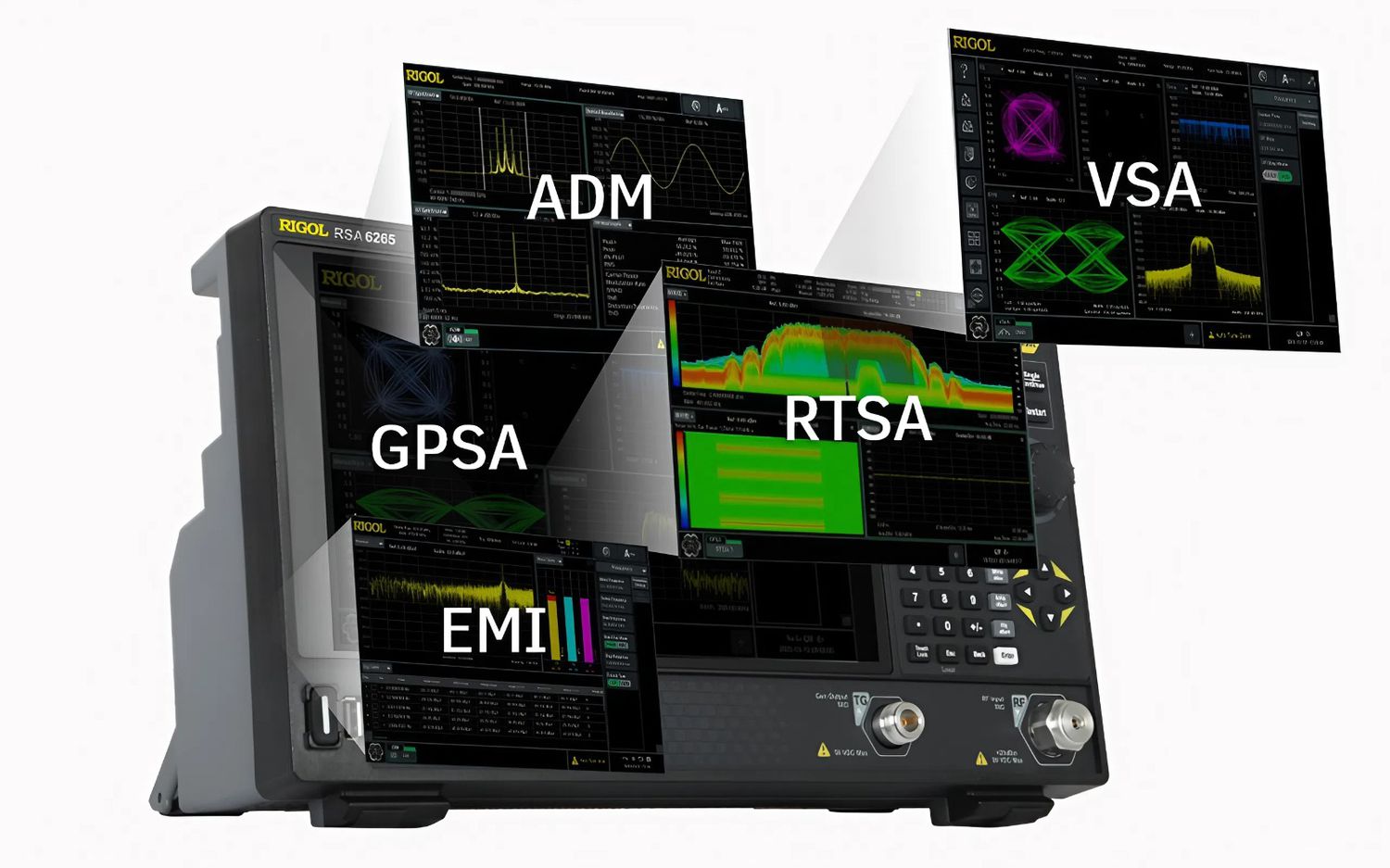
2. The device has 5 main operating modes: GPSA, RTSA, VSA, EMI and ADM. From traditional spectrum analysis, real-time spectrum, to signal vector analysis, electromagnetic interference measurement or analog demodulation, the RSA6000 can handle it all without having to switch devices. Switching between modes is fast and smooth, helping the operator save a lot of time when testing many different types of signals.
3. The internal performance is supported by an extremely low noise floor, reaching -163 dBm with the pre-amplifier on and -108 dBc/Hz at 10 kHz offset. These figures not only demonstrate the ability to detect weak signals, but also reflect the stability of the amplitude measurement. In practice, when it comes to detecting small noise in environments with many strong carriers, a low noise floor is crucial.
4. 10.1 inch high resolution multi-touch screen, allows to display multiple analysis windows at the same time. Engineers can observe real-time spectrum, density chart, spectrogram or PvT chart on the same interface without switching between tabs.
Applications in labs and production lines
In actual production, monitoring wireless signals, testing RF modules, detecting EMI interference or identifying sources of crosstalk is a daily task.
- In IoT device production lines, detecting hidden interference or intermittent error signals is extremely difficult when using a scanning spectrograph. Just one wrong signal pulse in a data transmission cycle of a few hundred microseconds can completely miss the test result. The RSA6000 solves this thoroughly thanks to its ability to continuously collect data and instantly display it as a color spectrogram. Engineers can see each noise point change over time, helping to track down the cause much faster than with the scanning method.
- In the R&D field, the RSA6000 is especially useful for complex signal analysis such as QAM 256 or multi-level PSK. With a vector analysis range of 200 MHz and a sampling rate of 256 MSa/s, the device can easily evaluate signal distortion, check EVM, BER or other modulation forms without additional hardware.
- For EMC departments, the RSA6000 series also has optional EMI Application software, which meets CISPR 16-1-1 standards, supports quasi-peak, average, RMS detectors, and automatic report generation. Helps shorten the emission testing process, especially in the pre-certification phase of products.
The real difference is not in the specs
Experienced engineers don’t buy equipment just for higher frequencies or more bandwidth. They care about response time, reliability, ease of use, and flexibility in real-world environments. The RSA6000 hits all of those marks.
A little-known strength is its compatibility with standard SCPI commands, and it supports the same syntax as the Keysight PXA series. This allows existing automation systems to easily integrate the RSA6000 without having to rewrite all of the control code. For labs using multiple devices, this compatibility is extremely important.
The RSA6000 is also highly expandable. USB, LAN, HDMI and trigger ports all support data synchronization, measurement sharing or remote control. The device also has an optional tracking generator module, which can measure attenuation, test transmission lines and RF component characteristics.
From an operational perspective, the interface has been refined to suit the habits of the modern engineer. All operations can be performed on the touch screen, or via a USB mouse and keyboard if working in a fixed test environment.
RSA6000 Series - Application Scale Trio
The three models RSA6085, RSA6140 and RSA6265 are not three simple levels of the same product but three options corresponding to three different work ranges.
RSA6085 with frequency range up to 8.5 GHz suitable for IoT applications, RF modules, industrial devices, Wi-Fi, Bluetooth, Zigbee or GSM signal testing.
RSA6140 raises the limit to 14 GHz, ideal for medium-range radar applications, telecommunications equipment, or RF research in lab environments.
RSA6265 with an extended frequency range up to 26.5 GHz, it is the choice for research institutes, 5G, 6G technology development centers, satellite systems and aerospace.
All share the same design philosophy: a compact 5 kg body, stable operation in the temperature range of 0 to 50°C, a recommended calibration period of 18 months and 128 GB of internal memory for storing large volumes of measurement data.
Conclude:
Above are the most notable points of the Rigol RSA6000 Series.
If you are looking for a device that can process signals quickly, intuitively, and serve well for complex measurements or high noise environments, the RSA6000 is a very worthy choice to consider.