physicochemical equipment
Practical chemistry teaching often depends on how well abstract concepts can be turned into measurable results. In laboratory training, that usually means working with instruments and experiment sets that connect chemical reactions with voltage, current, electrodes, conductivity, and observable material changes. This is where physicochemical equipment becomes especially useful for schools, universities, and research-oriented teaching environments.
Within this category, the focus is on equipment that supports hands-on investigation of electrochemical and related physicochemical principles. Rather than serving as generic lab supplies, these products help learners build a clearer understanding of reaction mechanisms, cell potentials, corrosion, energy storage, and quantitative measurement workflows in controlled educational settings.
Why physicochemical equipment matters in teaching and lab practice
Physicochemical experiments sit at the intersection of chemistry and measurement. Students are not only expected to observe a reaction, but also to interpret electrical behavior, compare materials, and relate experimental data to underlying chemical processes. For that reason, the category typically includes organized experiment sets, measuring accessories, electrodes, and supporting components designed for repeatable use in educational labs.
Compared with broader general chemistry equipment, these solutions are more closely tied to measurement-based chemistry work. They are especially relevant when the lesson objective involves electrochemical cells, electrode materials, corrosion protection, or the relationship between chemistry and electrical energy.
Typical applications covered by this category
A large share of the products highlighted here support electrochemical measurement and structured student experiments. In practice, that can include introductory exercises, electrochemical cells and potentials, corrosion-related demonstrations, and energy-storage topics. These setups are useful when educators need more than isolated components and instead want a coherent platform for multi-step practical sessions.
Some solutions are intended for standard instrument-based measurement, while others also support digital data acquisition through sensor-based workflows. This makes the category relevant not only for traditional chemistry teaching, but also for modern classrooms that integrate tablets, smartphones, or hybrid measurement methods. If your work extends toward broader measurement-driven chemistry topics, it can also be helpful to explore related atomic and molecular chemical equipment where appropriate.
Representative product types in this range
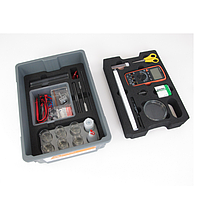
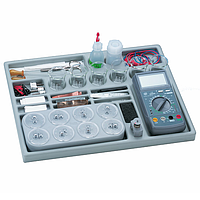
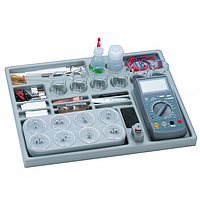
Several featured products from PHYWE show how this category is structured around complete learning systems rather than standalone items. The PHYWE 30505-88 TESS Electrochemical Measurement Set and PHYWE 30505-77 Electrochemical Measurement Set are examples of comprehensive kits that bring together measuring devices, leads, clips, vessels, electrodes, and handling accessories for electrochemical training.
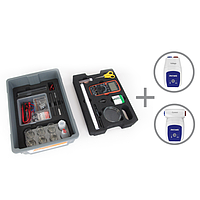
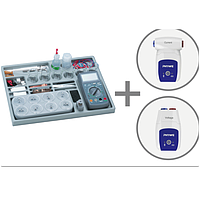
For environments moving toward connected measurement, the PHYWE 30505-88D TESS Electrochemical Measurement Set Digital and PHYWE 25307-88D Student Set Electrochemistry Digital illustrate a more digital approach. These sets are designed for experiment programs that can combine classical laboratory work with digital voltage and current acquisition, helping users compare manual observation with instrument-supported analysis.
The category also includes supporting materials such as the PHYWE 30506-88 Set Electrode Materials For TESS Electrochemical Measurement Set. This type of product plays a different but important role: it provides electrode-related materials needed to extend experiments, compare metals, and demonstrate how material choice influences electrochemical behavior.
How to choose the right equipment set
The best selection usually depends on teaching depth, group size, and the intended measurement method. If the goal is a compact introduction to electrochemistry fundamentals, a student-oriented set may be the more practical choice. If the lab requires broader experiment coverage with multiple accessories already organized in one system, a more complete electrochemical measurement set can save preparation time and improve consistency between sessions.
It is also useful to decide early whether the workflow should remain fully conventional or include digital sensors and mobile-device integration. Digital-ready sets can be advantageous where data logging, visualization, and faster result comparison are part of the teaching method. Conventional sets, on the other hand, may be preferable when the priority is direct instrument handling and step-by-step understanding of the measurement circuit itself.
Another key factor is the balance between core equipment and consumable or electrode materials. A full set may cover the main apparatus, but successful ongoing use often depends on having the correct accessories and replacement materials available for repeated practical sessions.
Benefits of complete electrochemical training systems
Well-structured physicochemical equipment helps reduce setup time and makes practical teaching more repeatable. When components such as multimeters, leads, clips, beakers, measuring blocks, and electrodes are already matched within one platform, instructors can spend less time assembling ad hoc arrangements and more time guiding the experiment itself.
There is also a pedagogical advantage. Organized systems make it easier to move from simple tests to more advanced topics such as electrode potential comparison, corrosion-related experiments, and energy-storage demonstrations. In a training environment, that progression matters because students can focus on interpreting results rather than troubleshooting incomplete setups.
Where the curriculum extends into adjacent lab areas, users may also compare this category with inorganic chemical equipment to build a more complete teaching laboratory around complementary experiment types.
The role of accessories and electrode materials
In physicochemical and electrochemical work, the supporting components are often just as important as the main kit. Electrode materials, graphite electrodes, metal strips, filter paper, and preparation items such as emery paper can directly affect what kinds of comparisons and demonstrations are possible in the lab. These are not secondary details; they shape the range of experiments that can be performed reliably.
For example, a dedicated electrode material set is particularly useful when instructors want to compare different metals in cell construction or discuss how electrode selection influences measured potential and reaction behavior. In this sense, accessories are part of the experimental method, not just add-ons.
Who this category is for
This category is especially suitable for educational buyers, laboratory coordinators, and institutions that need structured chemistry experiment equipment for repeated teaching use. Schools and universities can use these products to support practical instruction in electrochemistry, while training centers may value the standardized setup and easier preparation for group-based sessions.
Because the featured solutions are organized around learning objectives and experiment coverage, they are also relevant for buyers who need equipment that fits a teaching sequence rather than a single isolated task. That is particularly important in B2B procurement, where durability, consistency, and ease of restocking often matter as much as the experiment itself.
Final thoughts
Choosing physicochemical equipment is less about buying individual lab items and more about building a reliable framework for measurement-based chemistry education. Whether you need a complete electrochemical training set, a digital-ready student system, or electrode materials that expand the experiment range, the right selection should match your curriculum, measurement approach, and level of practical complexity.
By focusing on organized systems and compatible accessories, this category helps create more effective laboratory teaching environments where chemical theory can be tested, measured, and understood in a concrete way.
Get exclusive volume discounts, bulk pricing updates, and new product alerts delivered directly to your inbox.
By subscribing, you agree to our Terms of Service and Privacy Policy.
Direct access to our certified experts