Bidirectional power supplies for EV and HEV testing are programmable systems that can both deliver power to a device under test and absorb power returned by it. This two-way capability supports realistic testing of dynamic electric and hybrid vehicle systems.
They are commonly used to emulate high-voltage batteries, DC buses, fuel cells, and charging systems. When a test item regenerates energy, the supply can capture that energy rather than requiring a separate external load bank.
Summary: Bidirectional supplies source and sink power in four quadrants. They support battery emulation and regenerative energy handling. Common EV and HEV uses include BMS, inverter, charger, DC-DC converter, and V2G testing.
What is a bidirectional power supply in an EV or HEV test system?
A bidirectional power supply is a programmable power system that operates in four quadrants, allowing it to source power and sink power. It can transition between supplying a device under test and absorbing energy coming back from that device.
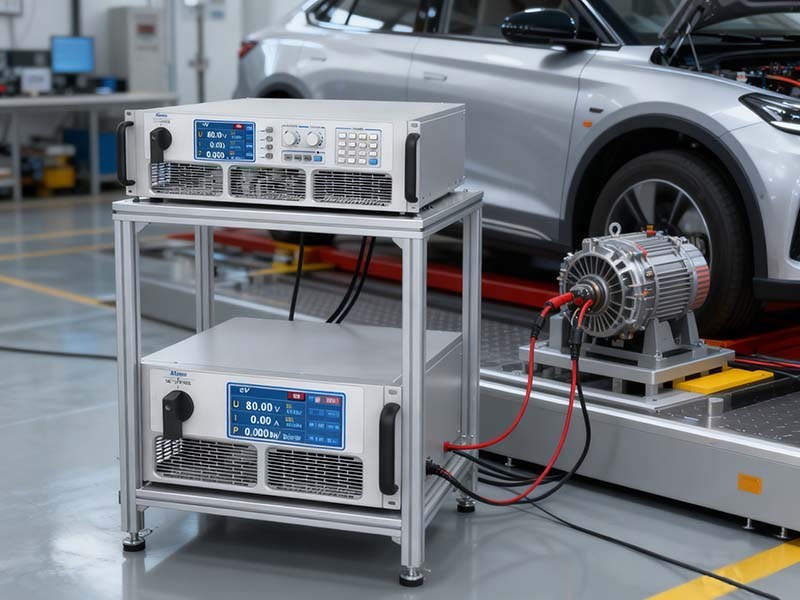
In EV and HEV laboratories, this operating mode is relevant because vehicle electrical systems do not draw energy in only one direction. Acceleration can require substantial current from the test source, while regenerative braking or inverter operation can return energy to the test system.
Why is bidirectional operation important for EV and HEV testing?
Bidirectional operation helps reproduce the changing power flow found in electric and hybrid powertrains. It enables closed-loop testing when the device under test alternates between consuming energy and regenerating it.
Compared with a DC power supply, a bidirectional system can absorb returned power during regenerative events. This supports energy recovery and can reduce reliance on external load banks, while also reducing heat dissipation associated with dissipating that energy.
| Operating condition | Power supply role | Testing relevance |
|---|---|---|
| Acceleration or high-load demand | Sources power to the device under test | Represents power drawn from a battery or DC source |
| Regenerative braking or inverter regeneration | Sinks returned power | Handles energy sent back by the device under test |
| Changing drive conditions | Transitions between sourcing and sinking | Supports dynamic, closed-loop operating modes |
How do bidirectional power supplies support battery and BMS testing?
For battery management system testing, a bidirectional DC power supply can simulate a battery pack without using a physical battery. The source data identifies controlled fault injection, charge/discharge cycling, and compliance testing as relevant activities in this environment.
Battery emulation may include modeling voltage, current, state of charge (SOC), and internal resistance. This gives engineers a controlled way to evaluate how BMS functions respond to changing battery-related conditions.
When are bidirectional supplies used for inverter and motor drive testing?
Bidirectional supplies are used when inverter and motor drive testing produces regenerated energy that must be absorbed by the test setup. Their precise control and fast transient response are described as useful for EV inverter testing and motor controller validation.
The ability to manage both outgoing and returned energy helps the test system follow power-flow changes associated with inverter operation. This is especially relevant where a test sequence includes rapid changes rather than a constant load.
Can a bidirectional power supply be used for OBC, DC-DC, and V2G testing?
Yes. For onboard charger (OBC) and DC-DC converter validation, bidirectional supplies support power flow at both the input and output sides. This enables evaluation of efficiency, thermal performance, and bidirectional operation under test conditions.
For EV charging and vehicle-to-grid (V2G) testing, a bidirectional supply can simulate grid behavior and help validate power flow between a vehicle and the electrical grid. This makes it applicable where charging and grid-interaction behavior must both be assessed.
Which capabilities should be considered when selecting a bidirectional power supply?
The appropriate selection depends on the voltage, current, dynamic response, safety, and automation needs of the test system. The supplied information highlights the capabilities below as key considerations for EV and HEV applications.
| Capability to assess | Why it matters in testing |
|---|---|
| Voltage and current range | Should suit the high-voltage EV battery or DC system being emulated. |
| Fast transient response | Helps reproduce dynamic drive-cycle conditions. |
| Four-quadrant operation | Allows seamless sourcing and sinking of power. |
| Power density | Can help reduce laboratory space requirements. |
| Isolation and fault protection | Supports safety requirements in the test environment. |
| CAN, Ethernet, and SCPI interfaces | Support automated test setups and communication with test equipment. |
How can bidirectional power supplies improve EV and HEV validation workflows?
By combining battery emulation, regenerative power handling, and automation interfaces, bidirectional supplies can support validation from early research and development through end-of-line production testing. They help test power electronics, control software, charging equipment, and power-flow behavior in controlled conditions.
For EV and HEV development, the central value is the ability to test both directions of energy flow with one programmable system. Selection should therefore align the supply’s voltage and current range, response behavior, protection features, and communication interfaces with the intended test procedure.