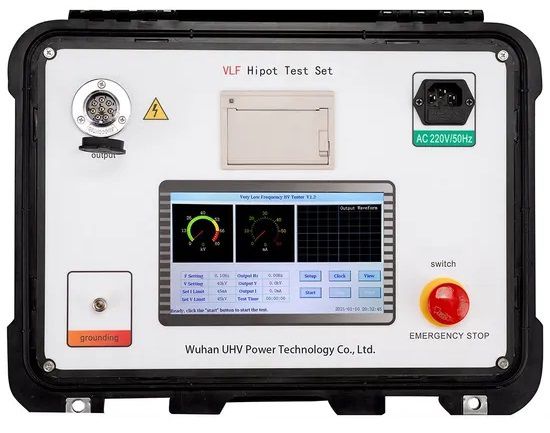
In electrical equipment inspection, a VLF low frequency tester provides a means of assessing insulation performance under high voltage. The test method can be used to examine insulation characteristics while reducing the power requirements of the test source compared with conventional 50 Hz AC testing.
What Is a VLF Very Low Frequency AC Voltage Tester ?
A VLF tester is a high-voltage test instrument that operates at a frequency significantly lower than the standard 50 Hz power frequency. Rather than relying solely on DC voltage or power-frequency AC voltage, VLF testing evaluates insulation response under very low frequency AC voltage.
For long cables or other equipment with significant capacitance, very low frequency testing can reduce the power required from the test source compared with testing at power frequency. Technical references also indicate that VLF testing can help identify early signs of insulation deterioration, including degradation associated with water treeing in insulating materials.
Test results should not be interpreted independently of the equipment's operating conditions. Assessment should consider the type of test object, applicable technical requirements, and the manufacturer's instructions.
Applications in Insulation Testing
A VLF very low frequency AC voltage tester is commonly used for insulation and withstand voltage testing of power cables, particularly XLPE-insulated cables. Technical references also describe applications involving large transformers, GIS, and high-voltage bushings.
The purpose of the test is to apply an appropriate voltage condition to evaluate the ability of the insulation system to withstand electrical stress and to identify potential abnormalities. For power cables, a VLF high-voltage tester can be used together with high-voltage cable fault locating equipment during inspection. For transformers, insulation and withstand voltage tests provide additional data for assessing operational reliability.
In practice, VLF testing can be combined with other diagnostic methods to provide a more comprehensive assessment. For example, partial discharge detection equipment can monitor partial discharge activity under high voltage, which may indicate early insulation deterioration. The selection and interpretation of each test method should follow an appropriate technical procedure.
Key Factors When Evaluating a VLF Test Instrument
Output Frequency Stability
Frequency is a direct parameter of high voltage tester. Even small frequency variations can affect the consistency of test conditions and the comparison of results. Output frequency stability is therefore an important consideration when operating the instrument.
Voltage Control
The test voltage must be accurately set and monitored according to the requirements of the test object. Precise output voltage control allows the operator to maintain defined test conditions and obtain a reliable basis for evaluating insulation performance.
Waveform and Load Capability
A sufficiently clean sinusoidal waveform helps minimize unwanted interference during testing. The instrument must also be capable of handling the capacitive load presented by the test object. This is particularly important when testing long cables or other equipment with high capacitance.
Safety Protection
High-voltage testing requires strict safety procedures. Protection features such as overvoltage, overcurrent, and flashover protection, as well as zero-start or zero-voltage startup functions, should be considered when selecting and operating the equipment.
The operator should verify all connections, establish the required safety zone, and check the condition of the test object before applying voltage.
Effective and Safe VLF Testing Procedures
First, clearly identify the test object, the purpose of the test, and the applicable technical requirements. Based on these factors, set an appropriate test voltage, frequency, and duration. A single fixed set of parameters should not be applied to every type of cable, transformer, or high-voltage equipment.
During testing, follow the operating sequence specified for the instrument and thoroughly inspect all connections and insulation of the test circuit. The test area must be controlled to prevent unauthorized personnel from entering. After the test, discharge the test object according to the prescribed procedure before handling or disconnecting it.
Regular maintenance and calibration also help maintain the stability and measurement performance of a VLF tester. Issues such as unstable output voltage, frequency drift, frequent overload protection activation, or damaged and inadequately insulated cables should be inspected before the equipment is used again.
Frequently Asked Questions
Can a VLF Tester Be Used for All Electrical Equipment ?
VLF testing is commonly applied to power cables and can also be used for certain large transformers, GIS equipment, and high-voltage bushings. Suitability must be confirmed based on the equipment type, test configuration, and applicable technical requirements.
How Should the Test Voltage and Duration Be Selected ?
Refer to applicable standards, industry regulations, or recommendations from the manufacturer of the test object. The settings should then be selected according to the equipment condition and specific test requirements. Arbitrarily selecting the test voltage or duration can reduce the value of the assessment and create safety risks.
Why Use VLF Testing Instead of 50 Hz AC or DC Testing ?
A low-frequency tester generates AC voltage at a very low frequency and can significantly reduce the power required from the test source when testing highly capacitive objects, particularly long power cables. The appropriate test method should still be selected according to the applicable technical requirements and characteristics of the test object.