Principle of operation in practical use
The circulator has three ports. In the lab, engineers usually plug the signal from the transmitter into port 1, the signal goes out to the antenna at port 2, and port 3 connects to the receiver or dummy load. The important thing is that the high-power signal cannot be returned to the transmitter, and the signal reflected from the antenna cannot damage the transmitter.
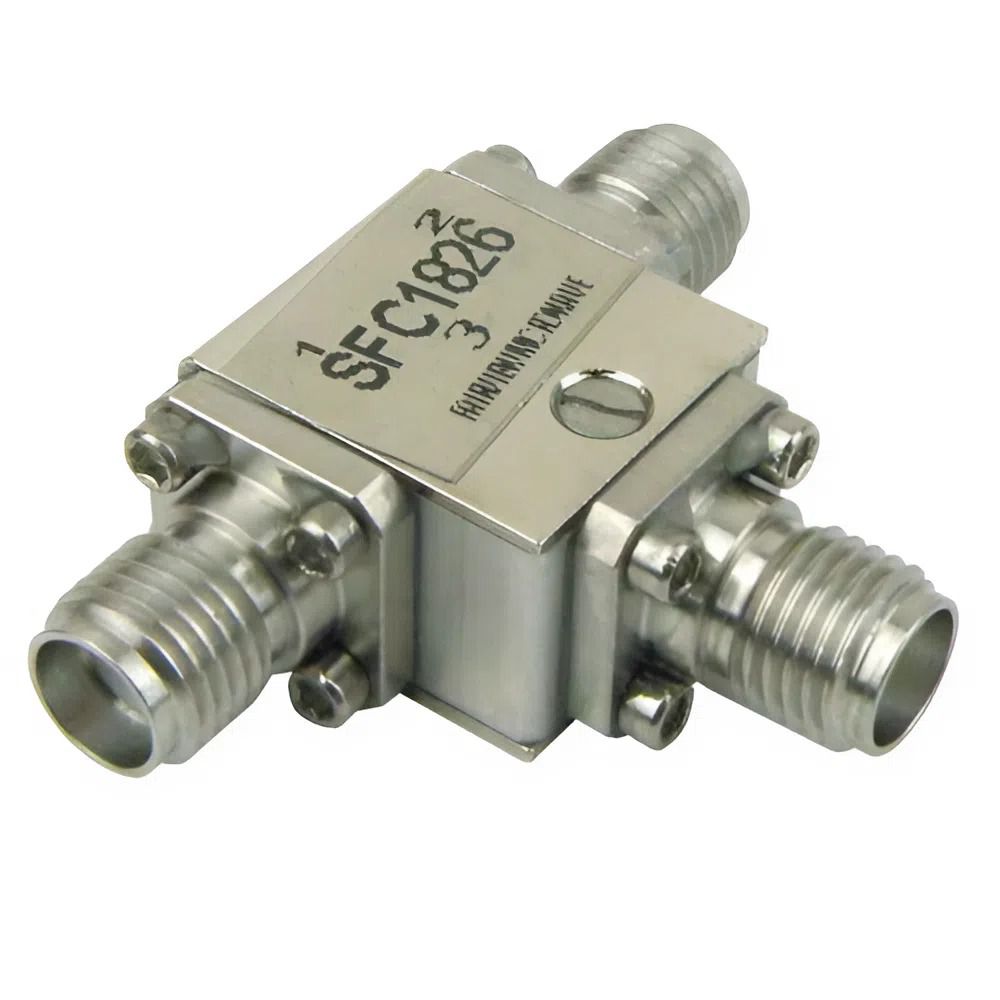
In fact, many small labs that have tested do not use circulators but only splitters. The result is that when the antennas mismatch, the reflected power is returned, burning the LNA or causing measurement errors. It is these problems that make the circulator an indispensable part of the testing process.
Applications in mobile telecommunications
In a BTS base station, the network operator must optimize installation costs. If two antennas for transmission and reception are installed separately, each tower location will require twice the space, cables and maintenance. Circulator allows transmission and reception on the same antenna while maintaining the necessary isolation. Service users may not see it directly, but thanks to the circulator, the base station is more compact, the signal is more stable and the network operator saves costs, thereby not increasing service prices for customers.
An engineer once shared that if the isolation between the transmitting and receiving ports drops below 20 dB, the voice quality will be affected immediately, users will feel the phenomenon of signal loss or signal instability. This shows that the signal transmitter has a direct impact on the experience of millions of subscribers.
Applications in military and aviation radar
Radars emit a very high-power signal to scan targets. The problem is that after transmitting, the system must immediately switch to receive mode to catch the extremely weak feedback wave. Without a circulator, the back-reflection power will destroy the receiver amplifier in just a few microseconds.
In fact, defense contractors when testing radars always use circulators as a mandatory layer of protection. Without a circulator, repairing an LNA or replacing a transceiver module can cost hundreds of thousands of dollars, not to mention slowing down the project progress.
Explore signal circulator products at EMIN
Applications in medicine and industry
In MRI machines, this device is used to separate the transmitting and receiving signals on the same coil. Without a circulator, the captured images can be noisy, leading to misdiagnosis. In hospitals, this directly affects the accuracy of treatment.
In industry and IoT, circulators allow multiple devices to share a single antenna. A business implementing a smart factory without one would have to double the number of antennas and wires, which is both costly and takes up installation space. With thousands of IoT devices, this difference is huge in terms of total investment costs.
Notes when choosing from implementation experience
When investing in equipment, engineers often look not only at the catalog but also at the actual conditions:
If used in the lab, they prioritize low insertion loss so that the measurement results are not distorted.
With BTS stations, they pay more attention to frequency range and stability over time.
With radar or high-power systems, the power tolerance index is a vital factor.
It can be said that the signal transmitter is the solution to help the RF system operate stably, reduce costs, protect the device and directly improve the user experience. When talking about the performance of mobile networks, the accuracy of radar or the quality of MRI images, the circulator is a silent but mandatory link.