An automotive paint thickness meter helps inspect a vehicle by providing measurable coating-thickness readings rather than relying only on appearance. Comparing readings across nearby panels and seams can reveal inconsistencies that may be associated with repainting, filler, rust repair, or collision work.
The substrate matters: steel, aluminum, and non-metal parts require different measurement principles. A reading difference is an inspection signal, not by itself a complete explanation of a vehicle’s history.
What does an automotive paint thickness meter measure?
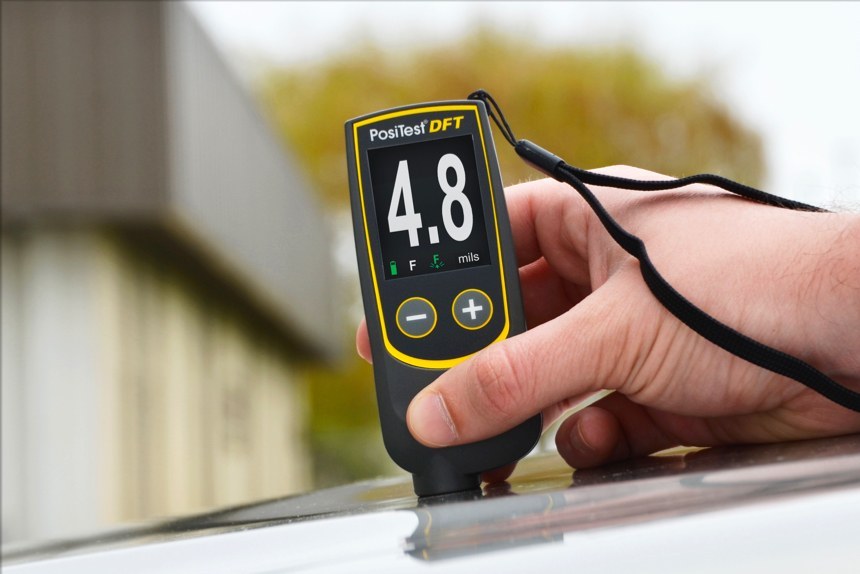
An automotive paint thickness meter measures the thickness of paint or another coating over a vehicle substrate. Hand-held electronic meters can provide quantitative readings that support a faster comparison of paintwork across a vehicle.
Visual checks still have a role: panel alignment, gaps, overspray, and changes in color or finish can indicate previous work. However, subtle differences can be difficult to see in poor lighting, bad weather, or on a dirty vehicle, whereas a meter provides a numerical result.
Why compare paint thickness readings around the vehicle?
Comparing readings is useful because paint thickness should generally be consistent around the vehicle, particularly within the same panel. A noticeably different measurement between adjacent panels, or a localized change within one panel, can indicate repainting or blending.
Take several readings rather than treating one result as conclusive. Measurements near seams, approximately one inch from an edge, help compare adjoining areas; if an area reads thicker than surrounding locations, measure nearby points to verify the pattern.
- Check consistency within each panel.
- Compare readings across seams and between adjacent panels.
- Recheck unusually high areas and extend measurements around them.
- Consider visible condition and the vehicle’s reported history alongside meter results.
Which vehicle areas are practical places to inspect?
Areas prone to collision damage or corrosion are practical places to compare paint thickness. The middle of fenders, rear quarter panels, and doors are common locations for bump-related damage.
Lower door edges and panels exposed to tire splash may be relevant corrosion areas on vehicles used in northern climates. On vehicles exposed to coastal spray, the hood, trunk, and upper fender and door areas—especially near moldings, handles, and emblems—can also merit attention.
Which measurement principle is used on steel, aluminum, and plastic?
Steel panels are measured with the magnetic principle, aluminum panels with eddy current, and non-metal substrates such as plastic and fiberglass with ultrasonic measurement. The appropriate technique depends on the substrate as well as the coating and part shape.
| Vehicle substrate | Measurement principle | Relevant instrument example |
|---|---|---|
| Steel | Magnetic (ferrous) | PosiTest DFT-F |
| Steel and aluminum | Magnetic and eddy current | PosiTest DFT-C |
| Plastic or fiberglass | Ultrasonic | PosiTector 200 |
Many modern vehicles combine these materials, such as steel doors and fenders, aluminum hoods or roofs, and plastic bumpers or mirrors. Selecting a meter that matches the inspected substrate is therefore important.
How do magnetic and eddy-current paint meters differ?
Magnetic meters are used over magnetic steel, while eddy-current meters are used over conductive non-ferrous metals such as aluminum. Electronic versions use a probe and display the measurement on an LCD.
Combo instruments incorporate both principles and may switch according to the substrate. This is useful for inspections involving both steel and aluminum body panels; a basic magnetic instrument cannot determine coating thickness on aluminum.
When is ultrasonic measurement needed for automotive paint?
Ultrasonic measurement is needed for paint over non-metal substrates such as plastic and fiberglass. The PosiTector 200 uses an ultrasonic pulse that travels through the coating and reflects from the substrate for analysis.
In some circumstances, ultrasonic measurement can assess individual layers in a multilayer coating system. This approach is relevant for vehicle components such as plastic bumpers, where magnetic and eddy-current techniques are not the applicable methods.
How do PosiTest DFT and PosiTector 6000 fit automotive inspection?
PosiTest DFT is a hand-held, non-destructive paint meter for automotive paint on aluminum or steel panels. The PosiTest DFT-F (Ferrous) measures paint on steel panels up to 40 mils (1,000 μm), while the PosiTest DFT-C (Combo) is intended for both steel and aluminum panels.
The source states that PosiTest DFT meters have 3% accuracy and 0.1 mil (2 μm) resolution. PosiTector 6000 meters provide similar measurement capability with higher accuracy and resolution, and certain configurations offer memory and print capability for logging results.
Can a paint thickness meter prove that a vehicle was in an accident?
No. A paint thickness meter can identify patterns that warrant further inspection, but it does not independently prove the cause of a repair. Higher or inconsistent readings can be associated with repainting, paint blending, filler, or repair work, so results should be evaluated with physical inspection and available vehicle information.
In one documented example, readings across most of a vehicle were 4.2 to 4.5 mils (105–115 μm), while readings lower on one panel rose to 10.6 mils (270 μm) and then 36.8 mils (930 μm). Follow-up confirmed bodywork related to rust damage behind the front right tire.
Who uses automotive paint thickness meters?
Automotive paint thickness meters are relevant to body shops, dealerships, painters, appraisers, inspectors, detailers, auction buyers, insurance adjusters, collectors, and professional car buyers. They support assessment of paint condition when determining a vehicle’s value or when controlling paint applied to or removed from a vehicle.
For used-vehicle inspection, the central value is speed and repeatability: multiple readings can be taken quickly, then compared across the vehicle to identify areas that need closer evaluation.