Lubricating Greases testing
Reliable grease analysis matters wherever bearings, gears, couplings, and heavily loaded mechanical systems must operate under heat, pressure, or low-temperature conditions. In these environments, the right laboratory setup helps engineers and quality teams evaluate how a grease behaves in service, how stable it remains under shear, and whether it will still perform when temperature and load conditions become demanding.
Lubricating Greases testing covers a focused range of instruments and accessories used to examine flow behavior, torque response, shear stability, and related handling requirements in petroleum and lubrication laboratories. This category is especially relevant for routine quality control, formulation work, standards-based testing, and comparative evaluation of grease performance.
What this category is used for
Grease is a semi-solid lubricant, so its behavior cannot be assessed in exactly the same way as liquid oils. Test methods in this category are used to understand whether a sample can resist structural breakdown, maintain workable consistency, and support mechanical motion under specified conditions. These measurements are important in sectors such as automotive, industrial maintenance, manufacturing, transportation, and lubricant production.
Many laboratories work to recognized ASTM procedures to ensure repeatability and comparability. That is why this category includes not only complete instruments, but also supporting items such as thermometers, glassware, gauges, and heat transfer fluid that help create a controlled and standards-aligned test environment.
Key test themes in lubricating grease laboratories
A practical grease testing workflow often combines several measurement approaches rather than relying on a single result. One major area is shear stability, which indicates how well the grease structure holds up when exposed to mechanical working. Another is low-temperature performance, where the goal is to understand whether the grease becomes too resistant to motion in cold operating conditions.
Flow-related evaluation is also critical. Apparatus designed for grease mobility testing help determine resistance to movement under prescribed conditions, supporting low-temperature and field-suitability assessments. For laboratories that also evaluate adjacent petroleum properties, related categories such as fuels testing and flash testers can complement the broader quality control workflow.
Representative equipment in this range
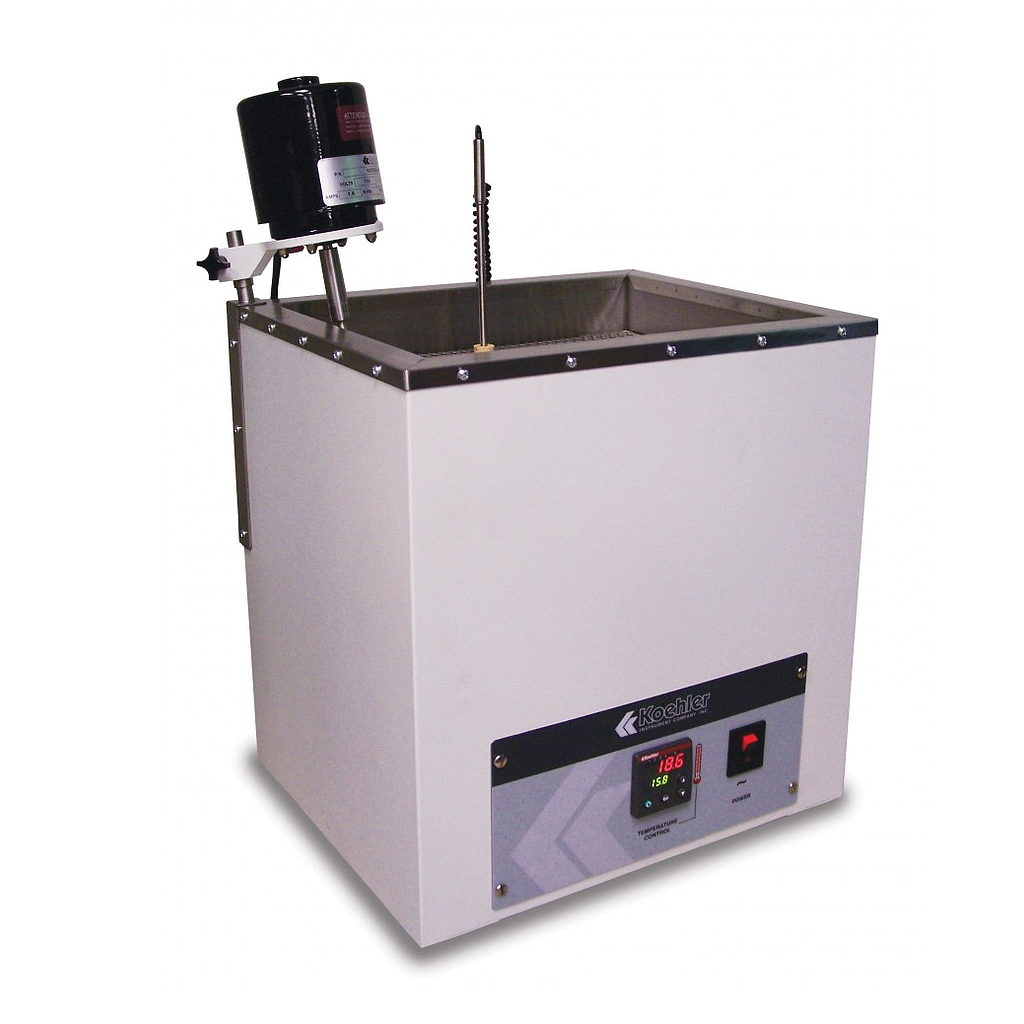
Several instruments in this category are designed around established grease test methods. For example, the Koehler K18305 Roll Stability Tester (Single-Unit), K18325 Roll Stability Tester (Double-Unit), and K18345 Roll Stability Tester (Four-Unit) are intended for evaluating the shear stability of lubricating greases. The different unit configurations can help laboratories match throughput requirements, from lower-volume testing to more frequent or parallel sample evaluation.
For cold-condition assessment, the Koehler K18854 Low Temperature Torque Apparatus and Koehler K18855 Low Temperature Torque Apparatus are relevant where torque behavior at reduced temperature is a key concern. The Koehler K18851 version is also available for ASTM D4693-oriented applications. In addition, the Koehler K22685 Grease Mobility Apparatus supports resistance-to-flow measurement under prescribed low-temperature conditions, which is useful when mobility is a critical service parameter.
This category also includes smaller but essential supporting items. Examples include the Koehler 250-000-02C ASTM Thermometer 2C, the Koehler K19492 Test Tube with Indentations, the Koehler K19499 Cork Ring Guide, the Koehler K194E7 Cup Plug Gauge, and the Koehler 355-001-002 Silicone Heat Transfer Fluid. These components play an important role in day-to-day lab operation, especially where method compliance and stable temperature control are required.
Why accessories matter as much as the main instrument
In grease testing, results depend not only on the primary apparatus but also on the consistency of the full test setup. A thermometer suited to the method range, properly selected glass components, and the correct heat transfer medium all contribute to better repeatability. Even small accessories such as guides or gauges can affect sample handling, bath setup, or dimensional checks within a standardized procedure.
That is why buyers often source complete laboratory ecosystems rather than a single headline instrument. If your workflow also depends on method-specific labware, it may be useful to review glass apparatus for ASTM test methods alongside grease testing equipment to ensure compatibility across the bench.
How to choose the right grease testing setup
The first step is to define the test objective. If the priority is to evaluate structural change under mechanical action, a roll stability tester is the logical starting point. If the concern is startup resistance in cold climates or refrigerated systems, a low-temperature torque apparatus may be more appropriate. Where the application requires understanding flow resistance at low temperatures, a grease mobility apparatus can be the better fit.
Next, consider laboratory throughput and workflow. Single-unit and multi-unit configurations can influence how many samples can be processed within a shift. Temperature capability, control stability, and method alignment are also important practical criteria. Laboratories with broader petroleum testing programs may also need related support equipment such as oil drying equipment or air drying equipment for preparation and handling steps in adjacent workflows.
Koehler as a recognized supplier in this category
Koehler is the main featured manufacturer in this category, with a product range that spans complete grease testing instruments as well as the practical accessories needed to support ASTM-style laboratory work. This is useful for buyers who want greater consistency in procurement, maintenance, and method-related setup across multiple benches or test stations.
Within one brand ecosystem, it is often easier to align instruments, consumable-type items, and replacement accessories with the intended procedure. That can simplify purchasing decisions for industrial labs, lubricant manufacturers, inspection facilities, and research teams that need dependable access to both core equipment and supporting components.
Typical buyers and application environments
This category is relevant for lubricant manufacturers, petrochemical laboratories, third-party testing facilities, maintenance organizations, universities, and industrial plants that monitor grease suitability for specific assets. In these settings, the equipment supports incoming inspection, formulation comparison, failure analysis, and ongoing quality assurance.
It is also valuable where there is a need to compare grease behavior across temperature ranges or under repeated mechanical stress. By using the right combination of apparatus and accessories, laboratories can build a more complete picture of how a grease is likely to perform in real operating conditions rather than relying on a single simplified measurement.
Final considerations
Choosing equipment for grease analysis is really about matching the method, the temperature range, and the expected sample volume to your laboratory goals. A well-selected setup may include a primary test instrument for torque, mobility, or roll stability, along with the supporting thermometers, gauges, glass items, and heat transfer materials needed for controlled execution.
If your team is reviewing options in Lubricating Greases testing, focus on the specific property you need to evaluate and the test standard your laboratory follows. That approach makes it easier to narrow the selection and build a practical, standards-oriented grease testing workflow with room to scale as requirements grow.
Get exclusive volume discounts, bulk pricing updates, and new product alerts delivered directly to your inbox.
By subscribing, you agree to our Terms of Service and Privacy Policy.
Direct access to our certified experts