The Picotest P2105A probe is a high quality measuring instrument designed to measure electronic parameters in a wide range of practical applications. With high accuracy and resolution, the P2105A probe can measure parameters such as voltage, current, impedance and capacitance. To better understand the features and uses of this electronic component, please refer to this article with EMIN!

Picotest P2105A probe - probe ‘‘Browser’’’
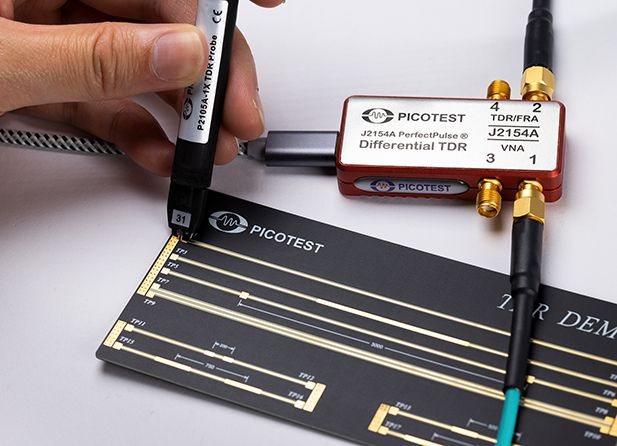
The Picotest P2105A probe is a 50 ohm single-port line TDR probe designed specifically for TDT/TDR applications. Featuring a 1-port reflector method, the P2105A supports a wide variety of measurements including impedance, ripple, noise, PCB power rails, VRM, and clock vibration. With its low inductance, this probe minimizes space constraints on dense PCBs and eliminates the need for additional SMA connections or other test points.
The P2105A is known as the 'browser' probe because of its ability to move easily and quickly from one point to another simply by resetting the probe points. This simplifies repeatable measurements, especially when there are multiple rails to evaluate and insufficient time or PCB iterations to provide a checkpoint implementation for each rail.
The P2105A comes in a variety of fixed pin steps (20, 31, 40, 50, 60, 70 or 100 mil spacing with 1X attenuation; GSG SMA and custom pitch are also available), making it compatible with all all 50 ohm devices, including the J2154A PerfectPulse TDR, vector network analyzer (VNA), oscilloscope and spectrum analyzer. The P2105A probe is also designed to work with a traditional single-ended TDR setup.
Outstanding features of the Picotest P2105A . probe
 Đầu dò Picotest P2105A
15GHz single-head precision high-bandwidth probe for all Time Domain Reflectometry (TDR) applications
Compatible with Picotest J2154A PerfectPulse TDR
Fixed throws available: 20, 31, 40, 50, 60, 70, 100 million or GSG SMA
Custom pitch spacing available
Compatible with all 50 ohm . instruments
Spring feet for easy landing
Short pins and integrated but detachable PDN cable for low coupling and optimal shielding
Handheld browser style for easy exploration and iteration; Handle design fits most probe holders
Slim low profile housing for comfort and visibility
Applications
Low Cost PCB Coupon Tester - Characteristic Impedance PCB Trace
Measure voltage ripple and noise
Measure PCB trace length, characteristic impedance and dielectric constant
Locate and detect impedance mismatches
Measure parasitic values of inductance and capacitance such as link wires, vias and ESL
Measure PCB trace path rise/fall time and over/under correction
Support loss-of-trace and cable models
Conclude:
This is a convenient and precise probe product for PCB TDR applications. With easy movement between test points and low inductance, the P2105A minimizes space constraints on dense PCBs and optimizes PCB rail analysis and evaluation. This product is also compatible with a variety of measuring instruments and is designed to work with a traditional single-ended TDR setup, saving time and improving measurement efficiency. All in all, the Picotest P2105A Probe is a product worth considering for use in TDR applications on PCBs.
Above are all the shares of the ad about the Picotest P2105A probe, hope that this article will help you in your work and how to use this electronic component. If you have any questions please feel free to contact Fanpage or Website to get it resolved as soon as possible