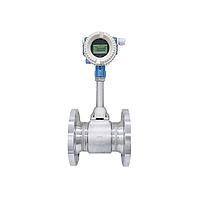
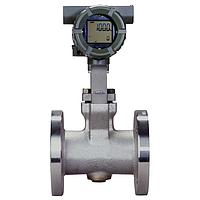
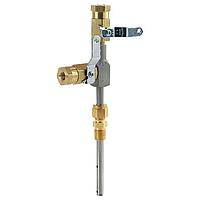
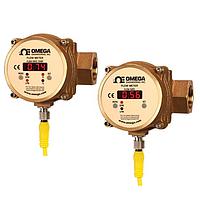
Vortex Flow Meters
When stable flow measurement is needed in demanding process environments, non-mechanical sensing technologies are often preferred for their repeatability and lower maintenance burden. Vortex Flow Meters are widely used for this reason, especially where users want a reliable signal output without relying on moving internal parts that can wear, stick, or drift over time.
Within industrial liquid handling, this meter type is especially relevant for monitoring process flow, chemical feed, utility lines, and other applications where signal consistency and installation practicality matter as much as nominal accuracy. This category focuses on compact vortex designs suited to corrosive liquid service, with models that can support common control and monitoring requirements through 4 to 20 mA or pulse-style output options.
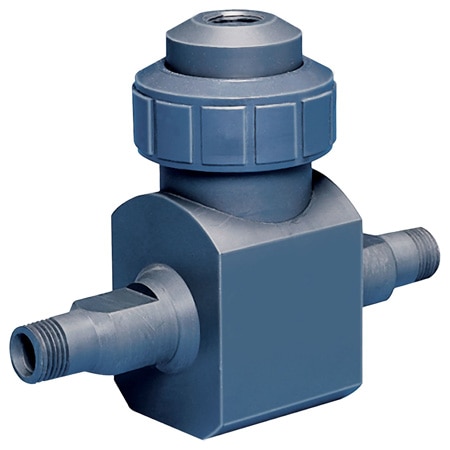
Why vortex technology is used in liquid flow measurement
A vortex flow meter works by detecting vortices created as fluid passes a bluff body inside the flow path. The frequency of these vortices is proportional to flow velocity, allowing the instrument to convert that behavior into an electrical signal for local systems, transmitters, or PLC-based monitoring.
Because the measuring principle does not depend on rotating vanes or gears, vortex measurement can be a practical choice where fluid cleanliness, repeatability, and reduced mechanical wear are important. For users comparing technologies, it can also complement alternatives such as electromagnetic flow meters or paddlewheel flow meters, depending on conductivity, media type, and installation goals.
Designed for corrosive liquid applications
The products highlighted in this category are geared toward corrosive liquids, with wetted materials based on CPVC and enclosure materials listed as CPVC or PVDF depending on the model. That material focus makes this category relevant for chemical handling and process lines where standard metal-body meters may not be the preferred fit.
Several models also carry IP66 and NEMA Type 4X enclosure ratings, which is useful in washdown or splash-prone industrial areas. Combined with gauge pressure handling up to 150 psi and operating temperatures from 0 to 66 °C, these meters are positioned for practical liquid service rather than laboratory-only use.
Typical configuration features in this category
Across the listed OMEGA models, users will find a consistent instrumentation profile: supply power from 8 to 28 Vdc, analog 4 to 20 mA output, repeatability around ±0.25%, and stated accuracy around ±1% of full scale for analog output. That combination fits well with common industrial control architectures where a stable analog loop is still the standard for trending, alarms, and closed-loop integration.
Some versions also support frequency pulse output, which may be useful for counting, batching logic, or integration with compatible controllers. If a system requires related components for installation or signal handling, it may also be helpful to review flow measurement accessories as part of the complete measurement loop.
Flow ranges and connection sizes available
One of the practical strengths of this category is the spread of available flow capacities and process connection sizes. The range shown in the listed products extends from lower-flow options such as the OMEGA FV-221 and FV-231 at 0.6 GPM, through mid-range models such as the FV-222, FV-223, FV-232, and FV-233, up to higher-capacity versions including the FV-225, FV-226, FV-235, and FV-236.
Connection sizes also vary, including 1/4 in, 1/2 in, 3/4 in, 1 in, and 1 1/2 in NPT male configurations. This matters because meter sizing should reflect actual operating flow, not just pipe size. Selecting an oversized meter can reduce sensitivity at lower flows, while undersizing can increase pressure drop and limit usable range.
How to choose the right vortex flow meter
Selection usually starts with four core questions: what liquid is being measured, what the normal and minimum flow rates are, what pipe connection is required, and what output signal the control system expects. In corrosive service, material compatibility should be verified first, followed by operating pressure and temperature limits.
It is also worth looking at response time, allowable pressure drop, and the control philosophy of the system. For example, a process that only needs trend visibility may prioritize simple 4 to 20 mA integration, while a batching or counting application may benefit from pulse output. In systems where mechanical adjustment is also important, related devices such as flow valves may be considered alongside the meter during system design.
Representative OMEGA models in this category
This category includes multiple models from OMEGA, giving buyers several options within a similar product family. For lower-flow applications, the FV-221 and FV-231 provide 0.6 GPM coverage in compact threaded configurations. For moderate flow requirements, the FV-222, FV-223, FV-232, and FV-233 serve as intermediate choices, while the FV-224 offers a 1 in connection for 4.2 GPM service.
Higher-capacity needs are represented by models such as the FV-225, FV-226, FV-235, and FV-236, all intended for corrosive liquid measurement with larger 1 1/2 in NPT male process connections. The presence of both CPVC and PVDF enclosure variants in the listed products gives additional flexibility when aligning meter construction with the installation environment.
Where these meters fit in a broader flow system
Vortex meters are rarely selected in isolation. In real installations, they are part of a broader flow management setup that may include valves, accessories, wiring, control inputs, and upstream process considerations. Their role is to provide a dependable signal that operators and control systems can use for visibility, dosing, alarm thresholds, or process consistency.
For buyers comparing categories, vortex technology can be especially attractive when a robust, electronically integrated meter is needed for corrosive liquids and a compact in-line form factor is acceptable. If visual-only indication is the main requirement, users may also compare this category with indicating flow meters to better match instrumentation complexity with application needs.
Final considerations
Choosing the right vortex flow meter comes down to matching the meter’s operating range, material construction, connection size, and output type to the actual process conditions. In corrosive liquid applications, those details have a direct impact on service life, measurement stability, and ease of integration.
This category brings together vortex flow meter options suited to industrial liquid monitoring where repeatability, analog output compatibility, and corrosion-resistant construction are key priorities. Reviewing the available models by flow range and connection size is usually the fastest way to narrow down the right fit for a specific line or process skid.
Get exclusive volume discounts, bulk pricing updates, and new product alerts delivered directly to your inbox.
By subscribing, you agree to our Terms of Service and Privacy Policy.
Direct access to our certified experts