Temperature Indicating Labels
When a full electronic monitoring setup is unnecessary, temperature labels offer a simple and practical way to verify whether a surface has reached a critical thermal threshold. In maintenance, HVAC, aerospace, cold-chain handling, and general industrial inspection, these indicators help teams document overheating or confirm that equipment has remained within an expected temperature window.
Temperature indicating labels are especially useful for spot checks, asset monitoring, and visual inspection programs. Because they are compact, easy to apply, and fast to read, they fit well into preventive maintenance routines as well as one-time validation tasks.

Where temperature labels fit in industrial monitoring
Unlike digital instruments that provide continuous measurement, indicating labels are designed for quick visual confirmation. They are typically applied directly to a surface, component housing, pipe, motor, panel, or shipped item to show whether a specified temperature point has been reached. This makes them valuable when power is unavailable, sensor wiring is impractical, or a low-cost monitoring method is preferred.
These labels are often used alongside broader temperature accessories and other verification tools. In many facilities, they complement handheld devices rather than replace them, giving maintenance teams a clear pass/fail or threshold-based indication at the point of use.
Common label types in this category
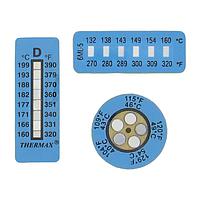
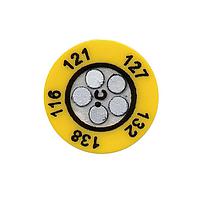
This category includes several label formats for different inspection needs. Some products are designed as single-point indicators, where one dot changes once a specific temperature is reached. Others use multiple dots arranged in a line or circular pattern, allowing users to see a temperature progression across several threshold values.
Examples in this range include compact micro-dot styles such as the OMEGA MD-150F-30 and OMEGA MD-300F-30, circular multi-point designs such as the OMEGA TL-C-130 and OMEGA TL-C-290, and strip-style labels such as the OMEGA TL-3-150-30 and OMEGA TL-E-330. For applications that require adhesive irreversible indicators for climate or process monitoring, Dwyer options such as the KS-0206 and KS-0207 are also relevant.
Most of the featured products in this category are non-reversible labels. Once the temperature event occurs, the visual change remains, making them useful for inspection records, warranty review, shipping control, and identifying intermittent overheating that may not be observed in real time.
How to choose the right temperature indicating label
The first selection factor is the required temperature range. Some labels are intended for low-temperature monitoring, such as the OMEGA TL-CC/9C for cold conditions, while others are suited for elevated surface temperatures reaching into the hundreds of degrees Fahrenheit, as seen in models like the OMEGA TL-E-330 or Dwyer KS-0207. Matching the label threshold to the actual operating window is essential for meaningful results.
The second factor is label format. A multi-point label is useful when you want to understand how far a temperature excursion progressed, while a single-point label is often enough when there is one critical limit that must not be exceeded. Physical size also matters in tight installations, which is why compact round labels and micro-dot designs are often chosen for small components or crowded assemblies.
Another consideration is whether you need irreversible or reversible indication. This category is centered on labels for visual temperature indication in general, but if your process requires permanent evidence of a thermal event, irreversible options are usually the preferred choice. If you need direct numeric reading or ongoing measurement rather than threshold indication, temperature meters and indicators may be the better fit.
Typical applications across industries
Temperature labels are used in many B2B environments because they support quick inspections without a complex installation. In building services and HVAC, they can help confirm whether ducts, coils, motors, or other surfaces are reaching expected temperatures. In maintenance programs, they are often applied to bearings, gearboxes, enclosures, or rotating equipment to reveal thermal stress over time.
They are also useful in transport and storage workflows. Low-temperature labels can support cold-chain verification, while higher-range labels help identify exposure to excessive heat during processing or shipment. Some multi-point products in this category are suited to aerospace, air handling, building maintenance, and general-purpose industrial use, where a permanent visual record is helpful for troubleshooting and compliance documentation.
Featured manufacturers in this category
OMEGA appears prominently in this range with multiple form factors, including single-dot, 3-point, 4-point, and 8-dot designs. This variety makes it easier to choose a label based on available space, required number of temperature points, and target threshold range. The lineup includes compact labels for smaller surfaces as well as strip formats for broader visual readability.
Dwyer is also represented with self-adhesive irreversible labels intended for climate monitoring and related applications. For buyers comparing brands, the practical difference usually comes down to threshold range, physical layout, and whether the application calls for a compact indicator or a broader multi-point label.
When to use labels instead of other temperature tools
Indicating labels are most effective when the goal is to know whether a temperature limit has been reached, not to capture a continuous temperature profile. They are a strong fit for hard-to-access surfaces, moving assets, distributed inspection points, and temporary studies where installing probes or data loggers would be excessive.
For deeper diagnostic work, labels can be paired with other thermal tools. A visual threshold indicator may first identify a problem area, while a thermal imaging camera or another instrument can then be used to investigate heat patterns in more detail. This layered approach is often efficient in maintenance and reliability programs.
What to review before ordering
Before selecting a label, confirm the expected minimum and maximum temperature, the required number of indication points, the available mounting space, and whether permanent evidence of exposure is needed. It is also worth checking pack quantity, since some products are supplied in different label counts depending on maintenance volume or inspection frequency.
If your application involves small components, a micro-dot or compact circular design may be easier to place accurately. For equipment where trend visibility matters, multi-point strip or circular labels can provide more context after the temperature event. The right choice depends less on brand alone and more on how the label will be applied, read, and documented in the field.
Conclusion
For maintenance teams, inspectors, and industrial buyers, temperature indicating labels provide a straightforward way to monitor thermal exposure without adding wiring, power, or complex instrumentation. With options spanning low-temperature monitoring, compact single-point labels, and multi-point irreversible designs, this category supports a wide range of inspection and process-control tasks.
Choosing the right label starts with the temperature threshold, then the format, and finally the level of traceability you need after the event. If your process depends on fast visual confirmation of surface temperature exposure, this category offers practical solutions for everyday industrial use.
Get exclusive volume discounts, bulk pricing updates, and new product alerts delivered directly to your inbox.
By subscribing, you agree to our Terms of Service and Privacy Policy.
Direct access to our certified experts