The role of multimeters for new electronics students
In the introductory phase, practical sessions often require quick measurements of many different values. If we rely solely on lab equipment, waiting or encountering old, poor quality machines can be disruptive. Having your own multimeter gives you more autonomy, allowing you to test components at home and tackle exercises without relying on shared equipment.
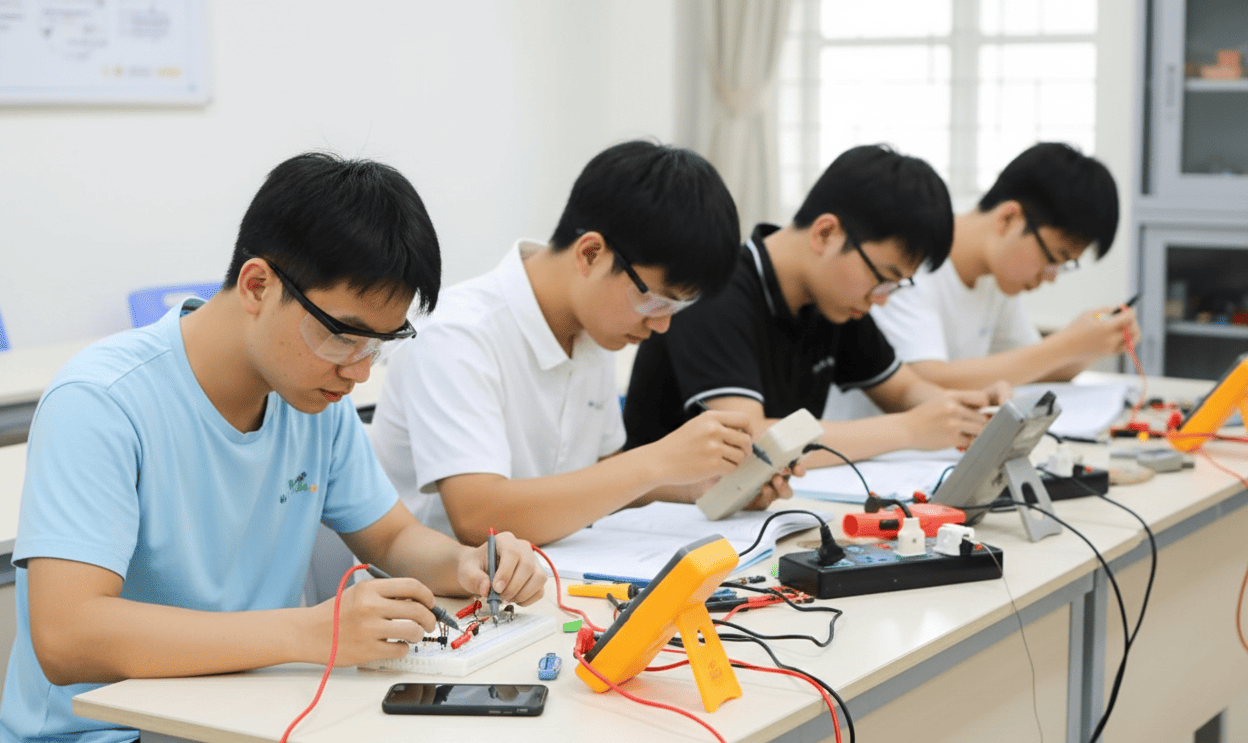
Most importantly, you can practice proper measuring techniques from the beginning. Inserting the wire in the right place, rotating the scale appropriately, and reading the correct value are foundational skills. If you get used to them early, the more advanced subjects will be easier to approach later.
Why digital multimeters are suitable for beginners
First year students need measuring instruments that are easy to understand and less confusing. Digital multimeters meet this need because the results are displayed directly on the screen. You don’t have to read the needle, don’t have to guess, and you also avoid errors due to off-angle viewing.
Basic subjects such as circuits, basic electronics or digital engineering mainly require measuring voltage, resistance, continuity and diodes. Therefore, a digital multimeter with basic scales is more than enough. There is no need for advanced functions because they are not useful at this stage and can easily confuse you.
Some technical factors to consider when choosing a multimeter
When choosing a device to study, there are several technical factors that directly affect the practical operation.
- The screen must be bright and easy to read so that you can measure in a crowded class and still see the value clearly.
- The knob must be firm to change the scale quickly and not slip while operating.
- The measuring wire should be soft, the core should be large enough and the contact tip should be good to limit flickering.
- The hard case and the ability to withstand light drops also help the device to be more durable when carried to each lab session.
In the low segment, some models often have errors such as measuring wires that break easily, plugs into component pins that do not connect or results that are sometimes correct and sometimes incorrect due to weak contacts. These small errors can easily make you waste time on repeated measurements. Choosing a stable device from the beginning will help the practice session go smoothly and increase accuracy in basic electronics labs.
Some 2025 multimeter models suitable for students
In the popular device group, UNI-T UT33D+ of UNI-T is a reasonable choice for students because of its simple operation and sufficient necessary measuring scales. This model is light, reasonably priced, easy to use, suitable for carrying in class.
HIOKI DT4256 is suitable for those who often do experiments using DC sources, amplifier circuits, sensor circuits or small current measurement exercises. The device scales quickly, reads stable numbers, so when you need to observe slow-varying signals
Fluke 101 is chosen by many students when they want to invest in equipment that is considered to be very durable, especially from the globally famous brand - Fluke. This model can be used throughout the first year to real projects.
All three lines are distributed by EMIN, so you can see them directly if you want to try the feeling of holding and operating. You can see the full list at: Handheld multimeter
Common mistakes students make when buying multimeters
Many students choose a device based on the lowest price without paying attention to the quality of the measuring wire, the stability of the scale or the durability. The result is that they have to replace it after a short time or study ineffectively because the measurement results are not stable.
Some students choose a model with too many functions while they do not actually use it. This slows down the operation and makes it easy to choose the wrong mode.
It is best to clearly define your needs: basic subjects, quick and neat operations. Once you have mastered the basic skills, you can upgrade to more advanced equipment for more specialized projects.
Conclude
For an introductory electronics student, a multimeter doesn’t need to be complicated. A device with a basic scale, an easy-to-read display, and durable leads is sufficient for most labs and homework. Choosing the right one from the start will save you money, help you operate correctly, and help you get started with practical subjects faster.