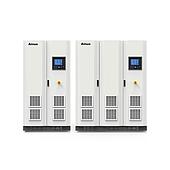
A regenerative grid simulator for EV charger testing is designed to do more than provide a fixed AC supply. It can source power to a charger and sink returned power, allowing controlled evaluation of bidirectional charging behavior.
This capability is especially relevant when a test must reproduce changing grid conditions, assess reverse-power operation, or run repeatable sequences without relying on a live utility grid.
Summary: A regenerative simulator can source and sink power. It supports controlled V2G and grid-event testing. Test software can automate repeatable sequences and data collection.
What is a regenerative grid simulator for EV charger testing?
A regenerative grid simulator is described as a four-quadrant power amplifier that acts as both a grid source and a load. In a test setup, it can supply AC power to the charger and absorb power when the charger sends energy back.
Unlike a basic power supply, this arrangement is intended to represent both directions of power exchange in a controlled laboratory environment. That makes it relevant to chargers designed for Vehicle-to-Grid, or V2G, operation.
Why is high-power EV charger testing challenging?
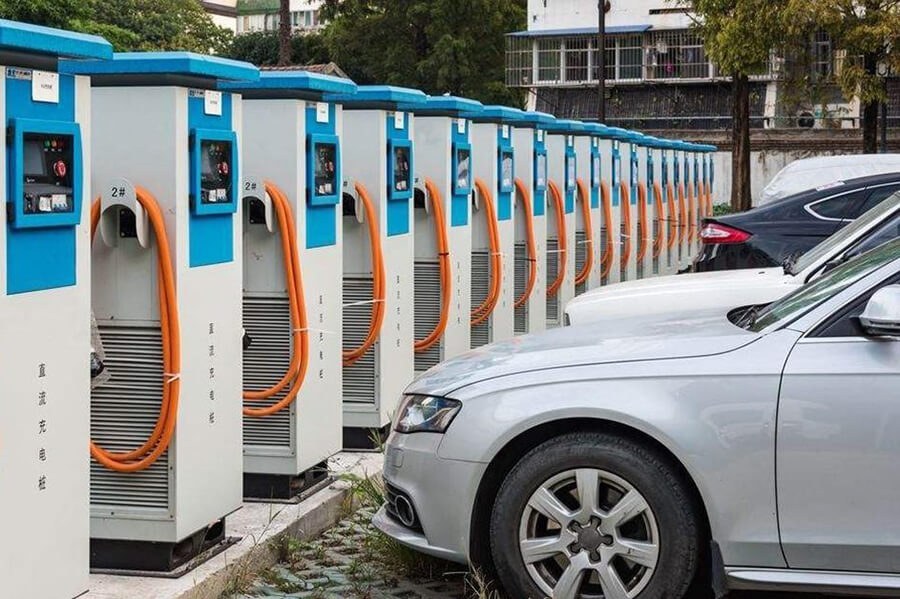
High-power DC fast chargers can require substantial test power, while a dissipative load converts that energy into heat. The resulting heat can also create a cooling requirement in the test environment.
Testing is also more involved than verifying that a charger delivers energy. Chargers may need to operate through voltage changes, frequency variation, harmonic distortion, and grid fault conditions.
| Testing challenge | Why it matters in a test setup |
|---|---|
| High test power | Dissipative testing turns energy into heat and may increase cooling demand. |
| Bidirectional operation | V2G testing requires equipment that can both source and absorb power. |
| Variable grid conditions | Chargers may need evaluation under sags, swells, frequency changes, harmonics, and faults. |
| Repeatable procedures | Testing many scenarios manually can be time-consuming and prone to variation. |
How does regenerative operation change the energy used in testing?
Regenerative operation returns absorbed energy toward the simulator's AC input instead of dissipating it entirely as heat. The source material states that this approach can recover over 95% of energy drawn during testing, depending on the test arrangement.
For discharge-mode testing, the simulator absorbs power returned by the charger rather than requiring a purely dissipative load. This directly addresses the energy and heat-management issue associated with high-power tests.
Note: Energy-recovery results depend on the specific simulator, charger, operating point, and test configuration. They should be confirmed from the applicable product documentation.
Which grid conditions can a simulator reproduce for charger tests?
A grid simulator can be programmed to reproduce conditions that are difficult or unsafe to create on a live grid. Examples cited in the source include voltage sags and swells, harmonic profiles, phase dropouts, phase imbalance, and weak-grid conditions.
These scenarios help engineers assess how a charger responds when the supply is not an ideal, stable sine wave. They also enable controlled “what-if” evaluation of more severe grid events.
How does a regenerative grid simulator support V2G testing?
V2G testing requires a system that can transition between delivering power and accepting power. Four-quadrant operation enables the simulator to behave as the grid when supplying the charger and as a grid-side load when absorbing returned energy.
This allows reverse-power functionality to be evaluated in a laboratory setting rather than through an uncontrolled connection to the utility grid. It also supports examination of how the charger responds during changes in power-flow direction.
What features should be reviewed for EV charger testing?
The required capabilities depend on the charger and intended test plan, but the source identifies power range, voltage and current range, waveform quality, transient response, software control, and measurement as key review areas.
| Feature to review | Testing relevance |
|---|---|
| Power and scalability | Determines whether the system can support the required charger power and possible parallel operation. |
| Voltage and current range | Must match the AC and DC-link conditions used by the charger under test. |
| Low waveform distortion | Provides a stable baseline before intentional disturbances are introduced. |
| Bandwidth and precision | Supports reproduction of fast transients and specified waveform events. |
| Software and logging | Helps create sequences, automate runs, and retain test data. |
| Integrated measurement | Supports measurement of power quality, efficiency, and harmonic content. |
Can a regenerative grid simulator help automate compliance-oriented tests?
Yes. The source describes software-controlled test sequences that can automate scenario execution, collect data, and produce pass/fail reporting. Automation can improve consistency when many operating points or grid events must be evaluated.
The cited standards include IEEE 1547, UL 1741 SA, IEC 61851, and ISO 15118. The applicable requirements should be determined for the charger, market, and test objective rather than assumed from a generic test sequence.
When is advanced grid emulation particularly useful?
Advanced emulation is useful when testing high-power charging, microgrid interaction, or broader V2X use cases such as V2Home and V2Load. These applications can involve interactions among chargers, local loads, energy sources, and changing grid conditions.
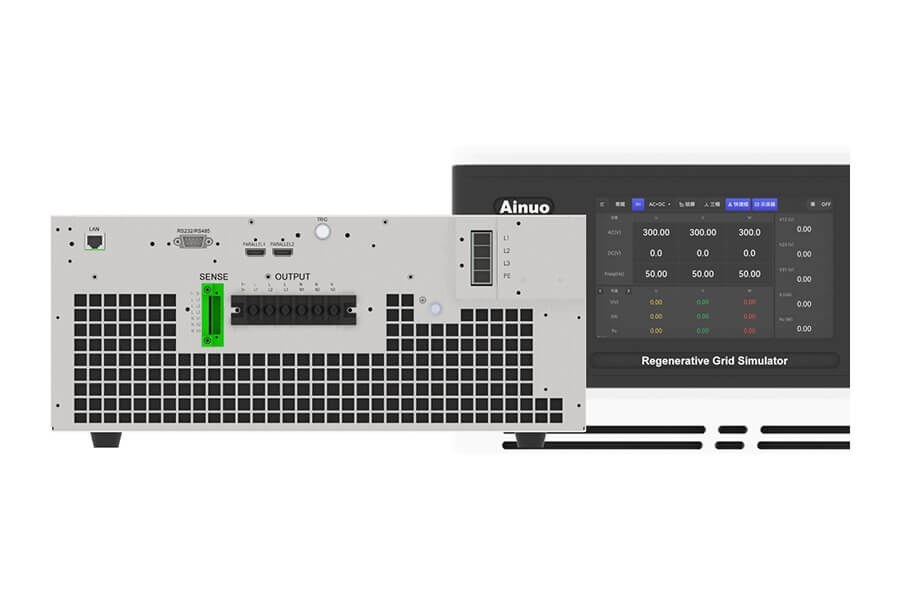
The available image identifies the Ainuo Regenerative Grid Simulator AC Power Supply ANRGS(F) as an example of this equipment category. Specific suitability should be evaluated against the voltage, current, power, measurement, and software requirements of the planned test.