Many Critical Defects Are Located in Areas That Are Difficult to Inspect
The advantages of industrial borescope is their ability to access areas that are extremely difficult to inspect with the naked eye, especially in confined spaces. This allows technicians to detect early-stage cracks that commonly appear in:
Early-stage cracks commonly appear in:
- turbine blade edges
- stress transition zones
- valve undersides
- hidden corners inside combustion chambers
- areas behind fan blades or along curved piping sections
Interestingly, many severe defects do not propagate in the most visually obvious direction. Instead, they tend to spread along stress paths or thermally fatigued material layers. As a result, viewing angle can sometimes be more important than camera resolution itself.
This is also why modern industrial borescopes focus not only on improving image sensors, but also on advanced multi-directional articulation capabilities in confined spaces. In complex enclosed structures, flexible viewing angles often contribute more to defect detection than simply increasing image sharpness.
The Hardest Defects to Detect Often Appear Very Early
Most serious mechanical failures do not begin with catastrophic breakage or immediate loss of function. In many cases, they start with extremely subtle changes: tiny pitting on a metal surface, abnormal carbon deposits, discoloration caused by overheating, or uneven wear developing along the edge of a turbine blade.
At this stage, the overall vibration level of the system may still remain within acceptable limits. Operating temperatures may not rise significantly either. If monitoring relies only on vibration analyzer or thermal camera, many early warning signs can remain virtually invisible.
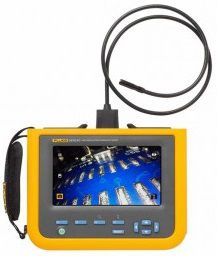
Industrial borescopes, on the other hand, make it possible to visually inspect the real condition of internal components without dismantling the entire assembly. In wind turbine systems, engine combustion chambers, and industrial gearboxes, technicians today often prioritize borescope inspections before deciding to open the equipment. This helps avoid unnecessary overhauls triggered by temporary operating anomalies that may not reflect actual mechanical damage.
Clear Images Is Not Always Guarantee Accurate Diagnosis
In real industrial environments, image quality depends heavily on factors such as surface reflectivity, oil contamination, moisture, carbon deposits, and the illumination angle of the probe.
A tiny crack on a polished metal surface can disappear completely if light reflects directly back toward the camera. Yet with only a slight adjustment in lighting angle, the same crack may suddenly become highly visible.
For this reason, experienced technicians do not simply insert a camera and capture images. They continuously adjust viewing angle, light intensity, focal distance, and reflection direction to distinguish ordinary surface scratches from actual fatigue cracking.
In high-temperature systems, inspection becomes even more challenging because oxidation layers and thermal discoloration can mask the true signs of material degradation.
Industrial Borescopes Are Changing the Way Equipment Maintenance Is Performed
In the past, maintenance strategies were primarily time-based. Equipment would be dismantled and inspected at scheduled intervals regardless of its actual condition.
Today, many facilities are shifting toward predictive maintenance. Instead of waiting for failure or performing routine disassembly, engineers monitor equipment condition over time to determine the optimal point for intervention.
Within this approach, industrial borescopes are no longer just visual inspection tools. They have become data collection instruments used to track equipment condition continuously over time, including:
- corrosion progression
- carbon deposit buildup
- material surface changes
- crack propagation trends
In continuously operating industrial systems, the cost of downtime can sometimes exceed the repair cost itself. In many situations, disassembling equipment may also introduce new risks, including:
- shaft misalignment during reassembly
- damaged sealing gaskets
- altered mechanical clearances
- contamination entering sealed assemblies
- extended downtime duration
That is why video borescope is increasingly treated as a priority step before deciding on a major overhaul. Beyond reducing unnecessary disassembly, it also helps engineers evaluate the actual condition of equipment during operation, enabling predictive maintenance strategies, performance optimization, and reduced system downtime.