However, after a period of operation, the differences become quite apparent. Some metal workbenches initially appear flat and aesthetically pleasing, and the measurements are accurate, but with prolonged use, slight surface changes are more likely to occur due to temperature, vibration, or continuous load application over extended periods. These deviations are usually very small and almost imperceptible to the naked eye; only when inspected with measuring equipment is it apparent that the surface is no longer as it was initially.
This is also why granite workbenches are still widely used in areas for mechanical detail inspection, equipment alignment, or surface flatness measurement in factories.
Metal tabletops are easily affected by ambient temperature
In a manufacturing environment, temperatures fluctuate almost constantly throughout the operation of machinery. There can be a difference of several degrees between morning and afternoon, not to mention areas near CNC machines, cutting machines, or those exposed to direct sunlight, which tend to heat up much faster.
Metals react significantly to heat, so even slight changes in the environment can cause surface dimensions to expand or contract. For typical tasks, this difference is negligible, but in measurements involving flatness or small errors, a change of a few microns in the tabletop can affect the test results.
That's why many testing rooms need to maintain a relatively stable temperature instead of having a constantly changing environment like the outside production area.
Granite retains its surface less change over time
Natural granite differs significantly from metal in that it reacts more slowly to changes in ambient temperature. Simply put, the surface expands and contracts less, thus maintaining its flatness for longer periods.
This is especially noticeable in countertops used for many years. If properly positioned and not subjected to strong impacts, the granite surface typically remains relatively uniform even after prolonged use.
In addition to temperature, the granite structure also makes it less prone to warping due to continuous load or pressure, unlike some thinner metal countertops.
Therefore, in places where heavy mechanical components are frequently placed or high-resolution measuring equipment is used, granite remains the preferred material.
The ability of the rock to limit vibration also makes a significant difference
Interestingly, the surface plate not only needs to be flat but also needs to effectively dampen vibrations so that the measurement process is not affected.
In large mechanical workshops, the floor almost always vibrates from the surrounding machinery. While this vibration might be imperceptible in some areas, the needles of measuring instruments or probes react very clearly.
Metal transmits vibrations quite quickly, so small oscillations from the workshop floor sometimes still propagate to the surface plate. Granite, on the other hand, has a greater mass and denser structure, resulting in significantly better vibration absorption. This is why many granite surface plates come with anti-vibration feet, especially in areas where environmental influences need to be minimized during measurement.
Read more:
What heavy objects should not be placed directly on the map table?
Granite surfaces are also less prone to oxidation or minor scratches
After prolonged use, metal workbenches are often susceptible to minor scratches, oxidation marks, or slight dents from the continuous handling of mechanical parts.
For surface measurement tasks, even a small bump on the workbench can alter the position of the workpiece.
Natural granite, with its relatively high hardness, is less affected by daily use. Furthermore, this material does not rust like steel, making long-term maintenance much easier.
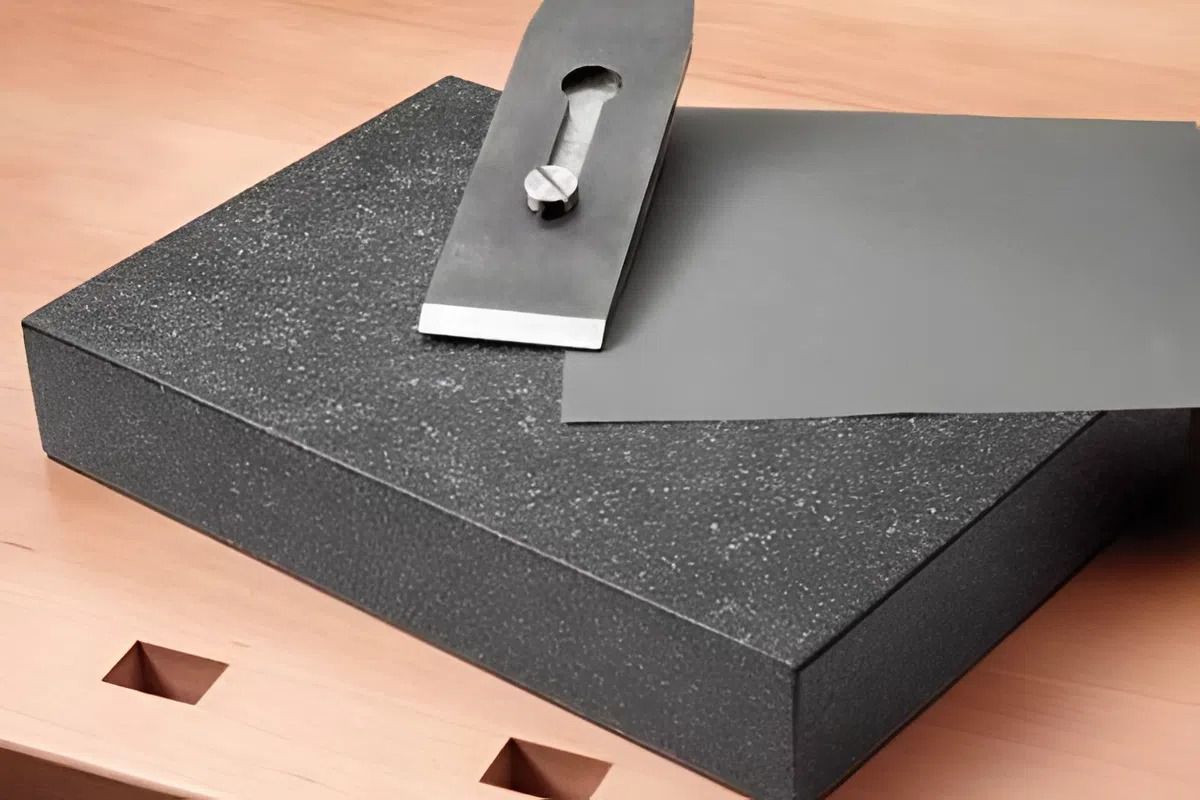
Natural black granite is also commonly used for surface measurement tables because its dark surface allows for easier observation of the measured parts, while maintaining a cleaner and more uniform appearance over time.
In reality, many high-quality metal surface plates are still used in industry, especially in applications requiring lightweight or very large dimensions.
However, when considering the ability to maintain a stable surface over time, minimize the effects of ambient temperature, and reduce vibration during testing, natural granite remains the more common material in many QC rooms and mechanical inspection areas today.