The difficulty lies in the fact that most compressed air leaks are difficult to detect with the naked eye. Some leaks are located high up, between operating machinery, or produce audible noises in the finished plant. These leak points can persist for months but are only discovered when costly operational improvements are clearly identified.
This is also why compressed air leak detection cameras are becoming increasingly common in manufacturers, especially in systems operating continuously across multiple shifts.
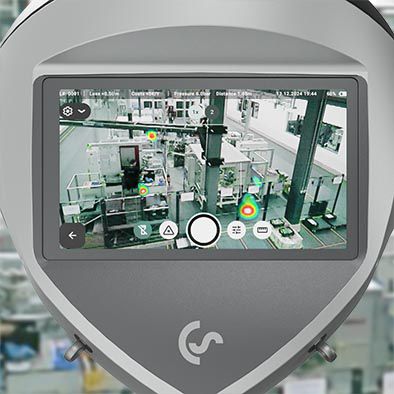
Scanning an area can reveal multiple leaks simultaneously
LeakCam 600 is a series of compressed air and gas leak detection cameras from CS INSTRUMENTS, developed for real-world factory inspection needs.
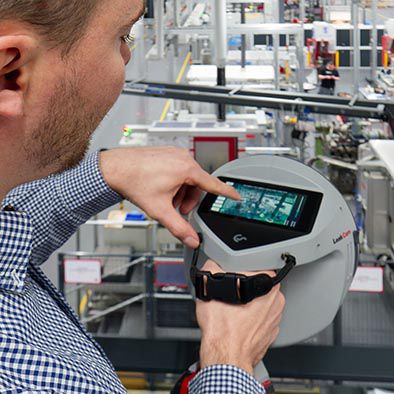
Instead of traditional leak detection methods, the device displays leaks directly on the camera screen. Technicians can quickly scan a large area and detect multiple gas leaks simultaneously, rather than having to inspect each connection individually.
This feature is particularly useful in systems with numerous valves, fittings, or pipes located close together. Manual inspections often take considerable time to pinpoint the exact location of leaks because the sound can easily be masked by surrounding machinery noise.
In large factories, inspection speed is often just as important as accuracy, especially when maintenance teams need to inspect hundreds of meters of piping in a short period.
Related article: LeakCam 600 detects gas leaks remotely via ultrasonic imaging.
Overhead pipelines can still be inspected remotely
One of the most time-consuming situations for the technical team is leaks located near the factory ceiling or behind large equipment clusters.
Many compressed air systems are installed high up, so conventional inspections require the use of lifts or considerable effort to access each area. Not to mention that some production lines are almost impossible to stop mid-shift just to check for leaks.
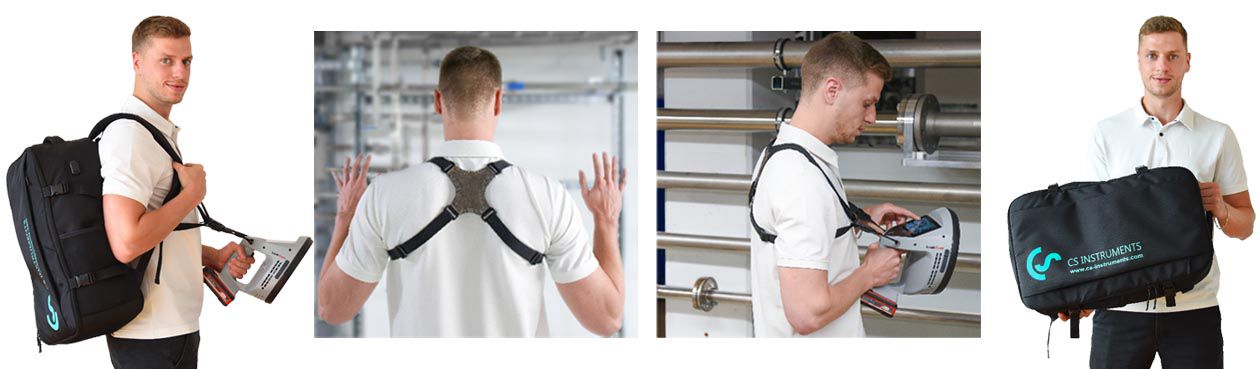
The LeakCam 600 supports leak detection from a distance, making inspections much more flexible. Technicians can stand below and quickly scan the entire pipeline and identify suspected air leaks without having to get close to each location.
This type of inspection is particularly suitable for:
+ Large-area factories
+ Overhead gas systems
+ Hard-to-reach areas
+ Continuously operating production lines
In multi-shift factories, reducing the time spent climbing to inspect each pipeline significantly reduces the workload for maintenance teams.
The camera also displays the level of gas loss as a percentage of operating costs
A key feature of the LeakCam 600 is that it doesn't stop at detecting leaks.
The camera can display the leakage rate in liters/minute and convert it into an approximate annual energy cost. This helps the technical team prioritize repairs instead of fixing everything at once.
In reality, some leaks are very small and have little impact, while others are large enough to cause the compressor to run continuously for many hours each day.
By directly seeing the amount of gas lost and converting it into operating costs, businesses can more easily understand why their electricity bills increase over time, even though production output remains relatively unchanged.
Inspections are still more convenient in dimly lit workshops
Not all technical areas are well-lit for easy inspection.
Many gas systems are located deep within maintenance areas or can only be surveyed during nighttime shifts after production has reduced. In such environments, visually locating leaks is often quite inconvenient.
The LeakCam 600, with its integrated wide-angle camera and LED lighting, makes inspection in low-light conditions much more proactive. Details on pipelines or valve assemblies are also easier to observe while moving continuously between different areas.
The device also comes with a strap to support prolonged operation, suitable for extended survey sessions lasting many hours in the factory.
Leaked data is stored and managed much more efficiently
After several inspections, a factory will often discover numerous small leaks scattered across various areas. Initially, the locations are easy to remember, but over time, relying solely on photographs or manual notes becomes confusing, especially when multiple technical teams are working simultaneously.
The LeakCam 600 allows for direct data management via Leak Reporter V2 or Leak Reporter Cloud software, making it much easier to track individual leaks, leakage levels, and progress of repairs.
All data can also be quickly exported as PDF or CSV files for maintenance, technical documentation, or internal energy management.
Many businesses now need to keep records for ISO 50001 compliance, so having clear reports readily available saves considerable time during periodic audits.
Multiple small leaks combined can significantly increase operating costs
The most easily overlooked aspect of compressed air leaks is that the system continues to operate relatively normally even though energy is being lost continuously every day.
The compressors are still running, the production line hasn't stopped, so attention is often focused on production rather than small leaks scattered around the factory. However, in continuously operating systems, even a few persistent leaks can significantly increase electricity costs over time.
That's why many businesses are now considering compressed air leak testing as part of their operational optimization strategy, rather than just addressing problems when they become apparent.