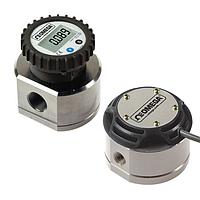
Positive Displacement Flow Meters
When oil flow has to be measured accurately across changing viscosity, startup conditions, or intermittent duty cycles, meter selection becomes especially important. In these situations, Positive Displacement Flow Meters are widely used because they measure a known volume of fluid as it passes through the meter, making them a practical choice for hydraulic oil, light oil, and similar media.
This category focuses on positive displacement designs for oil service, including meter and totalizer configurations suited to low, medium, and higher flow ranges. For maintenance teams, machine builders, and process engineers, these instruments are often selected when repeatable volumetric measurement matters more than a simple visual indication.
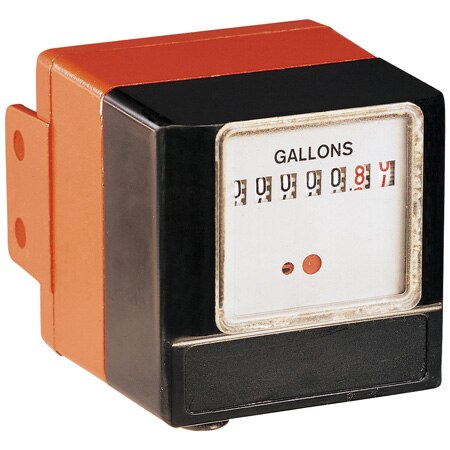
Why positive displacement technology is used for oil measurement
A positive displacement meter works by trapping and transferring fixed volumes of liquid through the measuring chamber. Because the measurement principle is based on volume rather than inferred velocity alone, this technology is often well suited to oils and other fluids where viscosity can affect the performance of some alternative flow meter types.
In industrial oil systems, this can be useful for batching, consumption monitoring, lubrication circuits, hydraulic power units, and transfer lines. Where the process requires pulse output for integration into controls or counting systems, some models in this category also provide amplified square wave output in addition to local totalizing functions.
Typical applications in industrial and OEM environments
Positive displacement flow meters are commonly applied where operators need to track actual fluid usage rather than estimate it. Typical use cases include hydraulic oil monitoring, light oil distribution, skid-mounted fluid systems, machine lubrication, and process lines where cumulative volume is important for maintenance planning or process control.
They can also be a good fit for installations that operate across broad flow ranges. In this category, the available examples span from very low flow starting points up to substantially higher capacities, which helps cover both compact equipment circuits and larger transfer applications.
Range coverage within this category
The products highlighted here are centered on OMEGA solutions for oil measurement. The range includes compact low-flow options such as the OMEGA FTB-30P and OMEGA FTB-31A, which are relevant when the process starts at very small flow rates and finer resolution is needed for totalizing or monitoring.
For mid-range and higher-capacity duties, models such as the OMEGA FTB-32, FTB-33, FTB-34, FTB-35, and FTB-36 illustrate how the line extends into larger throughput applications. Some versions are available as standard totalizers, while others add electrical pulse output, which can simplify connection to counters, PLC inputs, or supervisory systems.
Connection style and installation scale also vary across the range. Examples include NPT female process connections for general piping arrangements and flanged versions for larger line sizes, helping users align the meter body with the mechanical requirements of the application.
How to choose the right model
The first selection factor is the flow range. A meter should be sized so that the expected operating flow falls comfortably within its usable range, not just at the maximum rating. Choosing too large a meter for a very small flow can reduce measurement usefulness, while undersizing may create unnecessary pressure drop or limit operating flexibility.
The second factor is media compatibility. The products in this category are intended for hydraulic oil, light oil, and oil service, so the fluid type, temperature, and operating pressure should be checked against the meter’s rated limits. For example, some listed models support higher operating pressure at lower flow capacities, while larger units are intended for higher throughput with different pressure constraints.
A third factor is signal requirement. If the application only needs a mechanical or local totalized reading, a standard version may be enough. If the system must send pulses to automation hardware, then a pulse-output model with amplified square wave signal may be more appropriate. In broader flow systems, it may also be useful to compare other technologies such as electromagnetic flow meters when the media and installation conditions allow.
Totalizer-only versus pulse-output versions
One practical distinction in this category is the difference between models with local totalizing only and models that also include electrical output. Totalizer-focused versions are often suitable where operators need an on-site cumulative reading for fill quantity, consumption tracking, or maintenance records.
Pulse-output versions are more useful when the meter becomes part of a larger control architecture. A pulse signal can be counted by external electronics to support remote monitoring, automated batching logic, or production reporting. This is especially relevant in systems where flow data must be shared with HMIs, counters, or PLC-based controls rather than read only at the meter face.
Installation and system considerations
Even with a suitable meter type, installation details still affect performance. Pipe sizing, connection method, operating pressure, fluid cleanliness, and expected temperature should all be reviewed before final selection. A meter intended for a low-flow oil circuit will not be installed or maintained the same way as a heavier flanged unit on a larger transfer line.
It is also important to consider the surrounding system components. In some applications, related items such as flow valves help stabilize process conditions, while supporting parts from flow measurement accessories may be needed for mounting, connection, or signal handling. Taking a system-level view usually leads to a more reliable installation than choosing the meter alone.
When this category makes sense compared with other flow meter types
Positive displacement meters are often preferred when the process fluid is oil-based and the user needs direct volumetric measurement with strong repeatability. They are particularly relevant where low-to-moderate flow performance, totalizing, and viscosity-tolerant operation are more important than ultra-simple indication.
For other operating conditions, different meter families may be a better fit. If the requirement is primarily local viewing, some applications may align better with indicating flow meters. If the liquid and process conditions point toward another measurement principle, the broader flow measurement range may offer a better match. The right choice depends on media, piping, output needs, and the level of measurement accuracy required by the process.
Find a meter that matches your oil flow application
This category is designed for users who need dependable oil flow measurement across a range of capacities, connection styles, and signal requirements. From compact low-flow totalizers to larger flanged models for higher throughput, the selection supports many common industrial and OEM oil service applications.
If you are comparing models, focus on expected flow range, pressure, temperature, connection type, and whether the job requires local totalizing only or integration with external controls. That approach makes it easier to narrow the options and choose a positive displacement flow meter that fits the process rather than forcing the process to fit the instrument.
Get exclusive volume discounts, bulk pricing updates, and new product alerts delivered directly to your inbox.
By subscribing, you agree to our Terms of Service and Privacy Policy.
Direct access to our certified experts